Battle of the Nile (1798)
Nelson Battle of the Nile
At the Battle of the Nile in 1798, Nelson’s Royal Navy squadron included 13 ships of the line, plus the smaller HMS Leander and the sloop HMS Mutine. The French fleet was found anchored in Aboukir Bay, about 15 miles east of Alexandria; Royal Museums Greenwich notes that HMS Zealous, 74 guns, sighted the anchored French battle fleet.
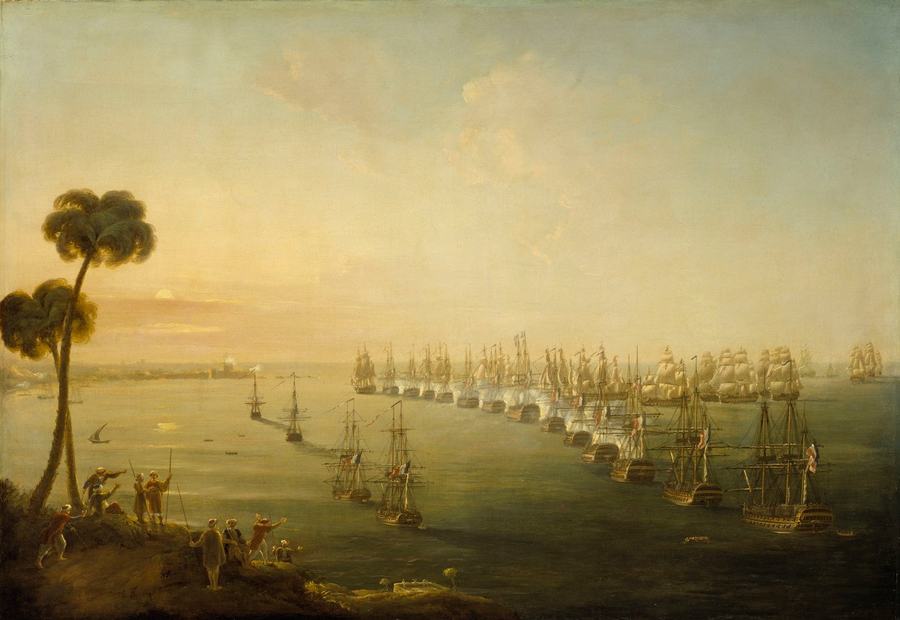
The Battle of the Nile, 1798: Nelson’s Victory at Aboukir Bay
The Battle of the Nile, fought on 1–2 August 1798, was one of the most decisive naval battles of the French Revolutionary Wars and one of the greatest victories in the career of Rear-Admiral Horatio Nelson. It took place in Aboukir Bay, near Alexandria in Egypt, where the French fleet lay at anchor after carrying Napoleon Bonaparte’s army across the Mediterranean. The battle ended in the destruction or capture of much of the French fleet and left Napoleon’s army isolated in Egypt. For the Royal Navy, it was a triumph of pursuit, intelligence, seamanship, aggression, and tactical daring.
Background: Napoleon’s Egyptian Expedition
In 1798, France was at war with Britain and its allies. Napoleon Bonaparte, already famous for his campaigns in Italy, proposed an expedition to Egypt. The plan had several purposes. Egypt could become a French base in the eastern Mediterranean, threaten British influence, and perhaps open a route towards India, the most valuable part of Britain’s overseas empire. The campaign was ambitious, imaginative, and dangerous.
The French expedition required a large naval operation. Troops, horses, artillery, supplies, scientists, engineers, and administrators all had to be transported across the Mediterranean. The fleet was commanded by Vice-Admiral François-Paul Brueys d’Aigalliers. It included powerful ships of the line, frigates, transports, and support vessels.
The British knew that a major French expedition was being prepared, but its destination was uncertain. Nelson was given command of a squadron and ordered to find the French fleet. His task was difficult. The Mediterranean was vast, communication was slow, and weather could scatter ships. Nelson’s squadron was damaged by a storm early in the chase, and he temporarily lacked frigates, the smaller scouting vessels normally used to search ahead of the main fleet.
Napoleon’s force successfully reached Egypt. The French captured Alexandria and pushed inland, winning the Battle of the Pyramids against the Mamluks. But the army’s survival depended on sea communications. If the French fleet remained secure, Napoleon’s expedition could be supplied, reinforced, and perhaps developed into a lasting eastern empire. If the fleet was destroyed, the French army would be stranded.
The French Fleet at Aboukir Bay
After landing the army, Brueys anchored the French battle fleet in Aboukir Bay, east of Alexandria. The anchorage seemed defensible. The French ships were positioned in a line, roughly parallel to the shore, with their strongest ships in the centre. Shallow water lay between the fleet and the coast, and Brueys believed this protected the inner side of his line. The seaward side faced open water and could be defended by broadside fire.
However, the position had weaknesses. The French line was not anchored close enough to the shoals to prevent British ships from passing between the French fleet and the shore. Some French ships also had limited readiness for immediate battle.
Many crewmen were ashore gathering supplies or assisting the army, and some ships were not fully prepared for a sudden evening attack.
The French flagship was L’Orient, a massive 120-gun ship of the line. She was one of the most powerful warships in the world and formed the centrepiece of Brueys’s fleet. Around her were other large French ships of the line, including Guerrier, Conquérant, Spartiate, Aquilon, Peuple Souverain, Franklin, Tonnant, Heureux, Mercure, Guillaume Tell, Généreux, and Timoléon.
Brueys expected that, if the British came, the battle would likely occur the next day. Nelson had other ideas.
Nelson Finds the French
Nelson had been searching intensely for the French fleet. He had gone first to Alexandria but arrived too early and found no enemy there. He then searched elsewhere in the Mediterranean, growing increasingly frustrated. When he finally returned towards Egypt, his ships discovered the French anchored in Aboukir Bay on the afternoon of 1 August 1798.
The sighting was critical. Nelson immediately understood the importance of the opportunity. The French fleet was at anchor, and the British had the weather and initiative. Some commanders might have waited until morning.
The light was fading, and attacking an anchored fleet in unfamiliar waters at night carried obvious risks. Ships could run aground, collide, or lose formation. Signals could be hard to see. But Nelson was determined.
He believed that delay would help the French. They might strengthen their position, move closer inshore, prepare their guns, or escape. Nelson’s instinct was to attack at once, using speed and aggression to turn discovery into victory.
The British Squadron
Nelson’s force consisted mainly of 74-gun ships of the line. His flagship was HMS Vanguard, commanded by Captain Edward Berry. Other British ships included HMS Goliath, Zealous, Orion, Audacious, Theseus, Minotaur, Defence, Bellerophon, Majestic, Swiftsure, Alexander, and Culloden. The smaller HMS Leander, a 50-gun fourth-rate, and the sloop HMS Mutine were also present.
A key figure in the opening of the battle was Captain Thomas Foley of HMS Goliath. Foley noticed that there was room to pass inside the head of the French line, between the French ships and the shore. This was a bold interpretation of the situation. If he was wrong, his ship could run aground. If he was right, the British could attack the French from both sides.
Foley was right.
The Attack Begins
As evening fell, HMS Goliath led the British attack. She passed around the head of the French line and anchored on the inshore side of the French ship Guerrier. HMS Zealous, commanded by Captain Samuel Hood, followed and attacked the same part of the enemy line. Other British ships followed in succession.
The opening British manoeuvre was devastating. The leading French ships had prepared mainly to fight on their seaward side. Now some were attacked from the landward side as well. The French van was trapped between British ships on both sides, unable to bring all its guns effectively into action.
The British did not simply sail past firing randomly. They anchored close to their opponents and delivered sustained broadsides. In age-of-sail naval warfare, anchoring in battle could be a way of fixing a ship in the best firing position. It allowed gunners to maintain steady fire at close range. In Aboukir Bay, this produced a brutal, ship-to-ship contest.
Guerrier and Conquérant, at the head of the French line, were overwhelmed. Spartiate, Aquilon, and other ships were soon heavily engaged. The British attack rolled down the French line, concentrating force where the French were vulnerable.
Nelson and HMS Vanguard
Nelson’s flagship HMS Vanguard entered the action against the French centre. During the battle Nelson was wounded. A piece of metal or splinter struck him on the forehead, tearing open the skin and temporarily blinding him with blood. Nelson believed the wound might be mortal and was taken below for treatment. The surgeon examined him and found that the injury, though serious and painful, was not fatal.
Nelson’s wound became part of the drama of the battle. He returned to command, but the action by then was being fought according to the aggressive principles he had already set. His captains understood his intentions. This was one of Nelson’s great strengths as a commander: he created a shared fighting doctrine among his officers. They knew he expected decisive action, close engagement, and initiative.
The Explosion of L’Orient
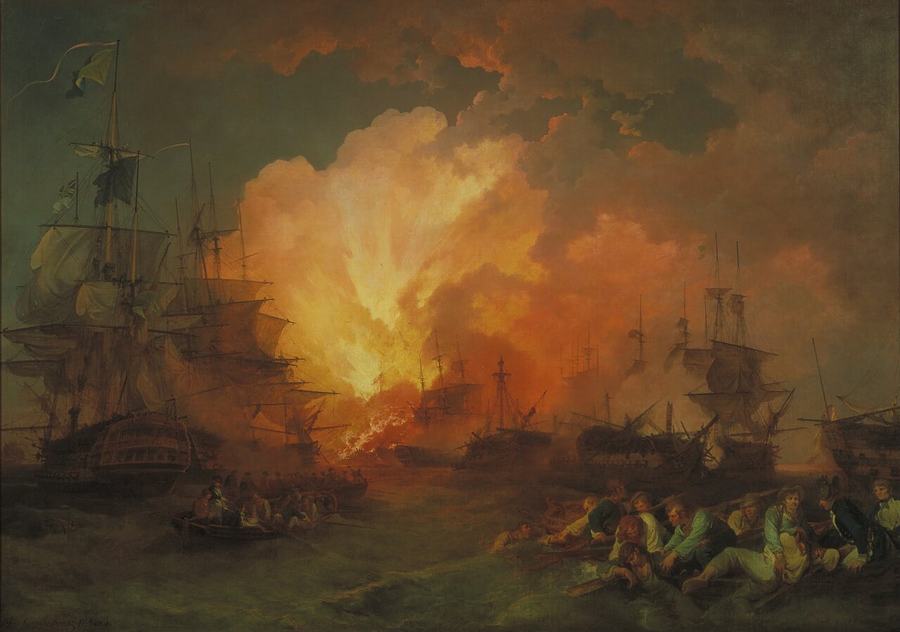
The Battle of the Nile by James De Loutherbourg. Tate, Britain, London
The most famous moment of the battle came with the destruction of L’Orient.
The French flagship, carrying 120 guns, was heavily engaged by several British ships. During the fighting, fire broke out aboard her. Fire was one of the greatest dangers in wooden warships. Ships carried powder, cartridges, rope, canvas, tar, timber, and paint.
Once flames spread, they could become impossible to control, especially in battle.
As the fire aboard L’Orient grew, British and French sailors alike became aware of the danger. Eventually the flames reached the magazine. Late in the evening, L’Orient exploded with enormous force.
The explosion lit the night sky and stunned both fleets. Burning wreckage was thrown across the bay. The sound was immense. For a short time, firing reportedly paused as crews were shocked by the destruction. The loss of the French flagship was a terrible blow to French morale and command. Brueys himself had already been killed or mortally wounded during the action. With L’Orient destroyed, the French centre was broken.
The explosion became the symbolic image of the Battle of the Nile. In paintings, prints, and popular memory, the burning and explosion of L’Orient represented the collapse of French naval ambition in Egypt.
The Battle Continues
Although the explosion of L’Orient was decisive, the battle did not immediately end. Fighting continued through the night and into the following day. Several French ships surrendered after being battered into wrecks. Others ran aground or were burned. A few managed to escape.
The British victory was overwhelming. Most of the French ships of the line were captured or destroyed. Only Guillaume Tell and Généreux, along with a few smaller vessels, escaped the disaster. The French Mediterranean fleet had effectively been annihilated.
The British also suffered damage and casualties. HMS Bellerophon, which had engaged the much larger L’Orient, was badly battered and dismasted. HMS Majestic also suffered heavily, and her captain, George Blagdon Westcott, was killed. Nelson’s squadron had won a great victory, but it had been a hard-fought battle at close range.
Tactical Importance
The Battle of the Nile is often remembered as an example of Nelson’s genius, but it was also a victory of British naval professionalism. Several tactical elements were crucial.
First, Nelson attacked immediately. He refused to allow darkness or uncertainty to delay him. This prevented the French from improving their position.
Second, British captains showed initiative. Foley’s decision to pass inside the French line was vital. Other captains followed the opportunity and turned the French anchorage into a trap.
Third, the British concentrated force. The French line was attacked in sections, beginning with the van. Several French ships faced multiple British opponents.
Fourth, British gunnery and ship-handling were highly effective. Anchoring close to the enemy allowed sustained broadsides at short range. The British crews were experienced and disciplined.
Finally, French weaknesses were exploited. The anchorage was imperfect, the line was vulnerable on the inshore side, and the fleet was not fully ready for immediate night action.
Strategic Consequences
The consequences of the Battle of the Nile were enormous.
Napoleon’s army in Egypt was cut off from France. Although it remained capable of fighting on land, its strategic position became precarious. Supplies, reinforcements, and communication were now far more difficult. Napoleon’s dream of using Egypt as a base for eastern expansion was badly damaged.
Britain regained naval dominance in the Mediterranean. The victory encouraged Britain’s allies and helped restore confidence after years of revolutionary war. It also contributed to the formation of the Second Coalition against France.
For the Ottoman Empire, the destruction of the French fleet mattered greatly. Egypt was nominally Ottoman territory, and Napoleon’s invasion had alarmed the Ottoman government. The British victory made it easier for Britain and the Ottomans to cooperate against the French presence in Egypt.
For Nelson personally, the battle transformed his fame. He was already respected after earlier service, but the Nile made him a national hero. He was created Baron Nelson of the Nile, and his reputation spread across Europe. The victory established the pattern of Nelsonic warfare: find the enemy, attack boldly, close with them, and destroy them.
Famous Royal Navy Figures at the Battle
Several notable Royal Navy officers served at the Battle of the Nile.
Horatio Nelson commanded the British squadron from HMS Vanguard. His determination to attack immediately defined the battle.
Captain Edward Berry, Nelson’s flag captain in Vanguard, played an important role in managing the flagship during the action.
Captain Thomas Foley of HMS Goliath made the crucial decision to lead inside the French line, opening the way for the double attack.
Captain Samuel Hood of HMS Zealous followed closely and helped overwhelm the French van.
Captain Thomas Troubridge of HMS Culloden was one of Nelson’s trusted commanders, though Culloden unfortunately ran aground and could not take part effectively in the main action.
Captain Benjamin Hallowell of HMS Swiftsure and Captain Alexander Ball of HMS Alexander arrived later in the action and helped engage the French centre, including L’Orient.
Captain George Westcott of HMS Majestic was killed in the battle, becoming one of the most prominent British casualties.
The battle was therefore not only Nelson’s victory. It was also a victory of his captains and crews.
Memory and Legacy
The Battle of the Nile entered British memory as one of the great naval victories of the age of sail. It was celebrated in newspapers, sermons, poems, prints, medals, and paintings. The destruction of L’Orient became a dramatic image of British sea power defeating French ambition.
The battle also foreshadowed Trafalgar. At the Nile, as at Trafalgar seven years later, Nelson used aggression and tactical flexibility to destroy an enemy fleet. He trusted his captains, encouraged initiative, and sought decisive battle rather than cautious manoeuvre.
For the Royal Navy, the Nile demonstrated the importance of command culture. Nelson did not need to control every ship once the battle began. His captains understood the objective and acted accordingly. This shared understanding allowed the British squadron to adapt quickly in the confusion of night battle.
Conclusion
The Battle of the Nile was one of the most important naval battles of the French Revolutionary Wars. It destroyed the French fleet in Egypt, isolated Napoleon’s army, restored British influence in the Mediterranean, and elevated Nelson to legendary status.
It was a battle of pursuit, risk, and decisive attack. The French fleet, anchored in what seemed a strong position, was caught unprepared for the speed and boldness of the British assault. The British captains exploited the gap between the French line and the shore, attacked from both sides, and overwhelmed the enemy ship by ship.
For Royal Navy history, the battle stands as a classic example of aggressive fleet command in the age of sail. It showed how seamanship, initiative, discipline, and courage could turn a dangerous evening attack into a strategic victory. Aboukir Bay became one of the great names in British naval history, and the Battle of the Nile remains one of Nelson’s defining achievements.
| Royal Navy ship | Guns / rate | Commander |
|---|---|---|
| HMS Vanguard | 74-gun third-rate | Rear-Admiral Horatio Nelson / Captain Edward Berry |
| HMS Goliath | 74-gun third-rate | Captain Thomas Foley |
| HMS Zealous | 74-gun third-rate | Captain Samuel Hood |
| HMS Orion | 74-gun third-rate | Captain Sir James Saumarez |
| HMS Audacious | 74-gun third-rate | Captain Davidge Gould |
| HMS Theseus | 74-gun third-rate | Captain Ralph Willett Miller |
| HMS Minotaur | 74-gun third-rate | Captain Thomas Louis |
| HMS Defence | 74-gun third-rate | Captain John Peyton |
| HMS Bellerophon | 74-gun third-rate | Captain Henry D’Esterre Darby |
| HMS Majestic | 74-gun third-rate | Captain George Blagdon Westcott |
| HMS Swiftsure | 74-gun third-rate | Captain Benjamin Hallowell |
| HMS Alexander | 74-gun third-rate | Captain Alexander Ball |
| HMS Culloden | 74-gun third-rate | Captain Thomas Troubridge |
| HMS Leander | 50-gun fourth-rate | Captain Thomas Thompson |
| HMS Mutine | 16-gun sloop | Lieutenant Thomas Hardy |
HMS Culloden was part of Nelson’s squadron but ran aground on the Aboukir shoals and did not take effective part in the main gun battle. HMS Leander, though smaller than the 74-gun ships, joined the action and supported the attack on the French centre. Contemporary summaries describe Nelson’s force as thirteen 74-gun ships of the line, one fourth-rate, and a sloop.
At the Battle of the Nile / Battle of Aboukir Bay in 1798, the French fleet under Vice-Admiral François-Paul Brueys d’Aigalliers included 13 ships of the line, 4 frigates, and smaller vessels.
French ships of the line
| French ship | Guns | Notes / fate |
|---|---|---|
| Guerrier | 74 | Captured by the British. |
| Conquérant | 74 | Captured by the British. |
| Spartiate | 74 | Captured; later served in the Royal Navy as HMS Spartiate. |
| Aquilon | 74 | Captured by the British. |
| Peuple Souverain | 74 | Captured; later served in the Royal Navy as HMS Guerrier. |
| Franklin | 80 | Captured; later served in the Royal Navy as HMS Canopus. |
| L’Orient | 118/120 | French flagship; exploded during the battle. |
| Tonnant | 80 | Captured; later served in the Royal Navy as HMS Tonnant. |
| Heureux | 74 | Driven ashore and captured; later destroyed. |
| Mercure | 74 | Driven ashore and captured; later destroyed. |
| Guillaume Tell | 80 | Escaped from Aboukir Bay. |
| Généreux | 74 | Escaped from Aboukir Bay. |
| Timoléon | 74 | Burned and destroyed. |
| French ship | Guns | Notes / fate |
|---|---|---|
| Diane | 40 | Escaped from Aboukir Bay. |
| Justice | 44 | Escaped from Aboukir Bay. |
| Artémise | 36 | Burned and destroyed. |
| Sérieuse | 36 | Destroyed / sunk during the battle. |
| French vessel | Type | Notes |
|---|---|---|
| Salamine | Brig / small vessel | Attached to the French fleet. |
| Railleur | Brig / small vessel | Attached to the French fleet. |