Horatio Nelson
Fleet officer
Horatio Nelson served in a role connected with the Royal Navy during napoleonic wars. This career belongs to the broader professional and institutional history of Britain’s maritime world.
He is associated with battle leadership and enduring place in british naval memory. This formed part of the way maritime service operated through discipline, knowledge, administration, or specialist expertise.
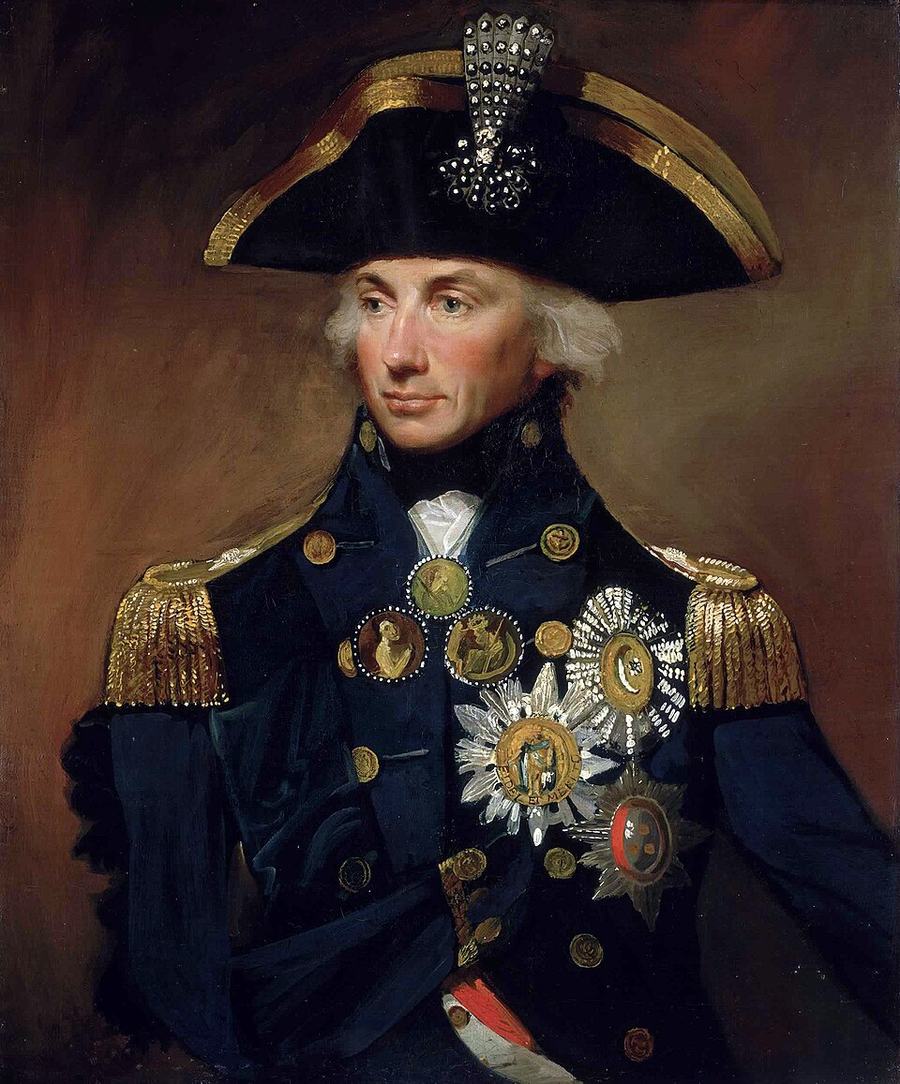
Portrait by Lemuel Francis Abbott, 1799. National Maritime Museum collection
Lord Horatio Nelson: The Life and Legacy of Britain’s Greatest Naval Hero
Horatio Nelson, Vice-Admiral of the Royal Navy, remains one of the most celebrated figures in British naval history. His name is inseparable from courage, leadership, tactical brilliance, and patriotic sacrifice. Best remembered for his victory and death at the Battle of Trafalgar in 1805, Nelson’s career helped secure British command of the seas during the long wars against Revolutionary and Napoleonic France. His life was marked by ambition, physical hardship, daring action, and a powerful ability to inspire the officers and sailors under his command.
Horatio Nelson was born on 29 September 1758 in Burnham Thorpe, Norfolk. He was the sixth surviving child of the Reverend Edmund Nelson and Catherine Suckling. His family was respectable but not wealthy, and Nelson’s early life was shaped by duty, religion, and discipline. His mother died when he was still a boy, a loss that affected him deeply. Through his maternal uncle, Captain Maurice Suckling of the Royal Navy, young Horatio gained the opportunity that would define his life. In 1771, at only twelve years old, he entered the Navy aboard HMS Raisonnable.
Nelson’s early naval service exposed him to the hardships of life at sea. He served in the West Indies, the Arctic, and the Indian Ocean, gaining experience in navigation, seamanship, and command. Like many officers of his generation, he advanced through patronage as well as ability, but Nelson quickly proved that he possessed uncommon determination. He suffered from seasickness throughout his life, an ironic burden for a man who became Britain’s most famous sailor. He also endured bouts of illness in tropical climates, yet his commitment to the Navy never wavered.
By 1779, Nelson had been promoted to post-captain at the age of twenty. This was a major step in a naval officer’s career, placing him on the path toward senior command. During the American War of Independence, he served in the Caribbean, where Britain fought both American and European enemies. Nelson developed a reputation for energy and aggressive leadership, though he was not yet widely known outside naval circles. In 1787, he married Frances “Fanny” Nisbet, a widow from Nevis. Their marriage began with affection, but Nelson’s long absences and later personal choices would place great strain upon it.
The outbreak of war with Revolutionary France in 1793 gave Nelson the opportunity to make his name. Serving in the Mediterranean, he took part in operations around Corsica, including the siege of Calvi in 1794. During this campaign, he was wounded in the face and lost sight in his right eye. This injury became part of his heroic image, but it was not the last serious wound he would suffer. Nelson’s courage and personal example impressed those around him, and he increasingly showed the qualities that would make him an exceptional commander: boldness, speed, and a willingness to take responsibility in uncertain circumstances.
Nelson’s fame grew after the Battle of Cape St Vincent on 14 February 1797. Serving under Admiral Sir John Jervis, Nelson made a daring decision that helped disrupt the Spanish fleet. He broke from the line of battle and engaged enemy ships at close quarters, eventually helping to capture two Spanish vessels. His actions were unconventional but effective, and they demonstrated his instinct for decisive action. Later that year, however, Nelson suffered a severe setback during an attack on Santa Cruz de Tenerife. The operation failed, and Nelson was badly wounded in the right arm, which had to be amputated. He returned to Britain in pain and disappointment, but his career was far from over.
In 1798, Nelson achieved one of his greatest victories at the Battle of the Nile. French forces under Napoleon Bonaparte had sailed to Egypt, threatening British interests in the Mediterranean and the route to India. Nelson pursued the French fleet and found it anchored in Aboukir Bay. On 1 August 1798, he launched a bold attack. His captains, trained and trusted by him, executed the plan with remarkable skill. The French fleet was devastated, and Napoleon’s army was left isolated in Egypt. The victory transformed Nelson into a national hero. He was created Baron Nelson of the Nile, and his reputation spread across Europe.
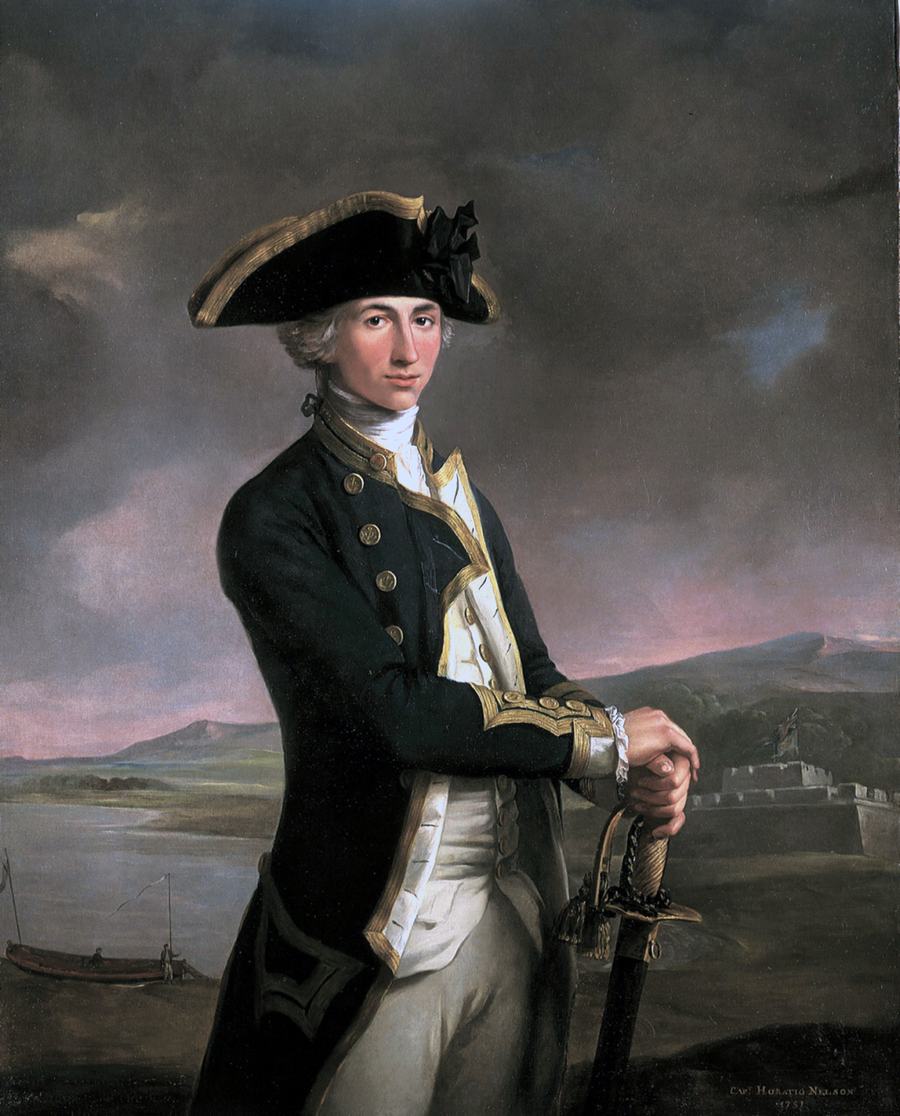
Captain Horatio Nelson, painted by John Francis Rigaud in 1781, with Fort San Juan. National Maritime Museum collection
Nelson’s personal life also became increasingly public and controversial. While in Naples, he formed a close relationship with Emma Hamilton, the wife of Sir William Hamilton, the British ambassador. Their affair became one of the most famous scandals of the age. Nelson and Emma had a daughter, Horatia, born in 1801. Nelson’s devotion to Emma conflicted with his marriage to Fanny, from whom he became emotionally separated. To many admirers, his private conduct was a flaw in an otherwise heroic life. To others, it revealed a deeply human side to a man often remembered in almost legendary terms.
In 1801, Nelson played a key role at the Battle of Copenhagen. Britain feared that Denmark, along with other northern powers, might threaten British naval supremacy. During the battle, Nelson famously ignored a signal to withdraw, placing his telescope to his blind eye and claiming he could not see the order. Whether the story is partly theatrical or entirely true, it perfectly captures Nelson’s character: determined, audacious, and unwilling to abandon a fight he believed he could win. The British victory weakened the armed neutrality of the Baltic powers and further strengthened Nelson’s standing.
Nelson’s greatest and final triumph came at the Battle of Trafalgar on 21 October 1805. By this time, Napoleon dominated much of continental Europe and had considered invading Britain. Control of the Channel and the wider seas was essential. Nelson, commanding the British fleet from HMS Victory, faced the combined French and Spanish fleets off Cape Trafalgar, near the coast of Spain. Before the battle, he sent the famous signal: “England expects that every man will do his duty.” It was a simple message, but it captured the spirit of national service and naval discipline.
Nelson’s battle plan was daring. Instead of forming a traditional parallel line, he divided his fleet into columns and attacked the enemy line directly. This exposed British ships to heavy fire as they approached, but it also aimed to break the enemy formation and create close combat, where British gunnery and seamanship could dominate. The plan succeeded. The Franco-Spanish fleet was decisively defeated, and Britain’s command of the sea was confirmed.
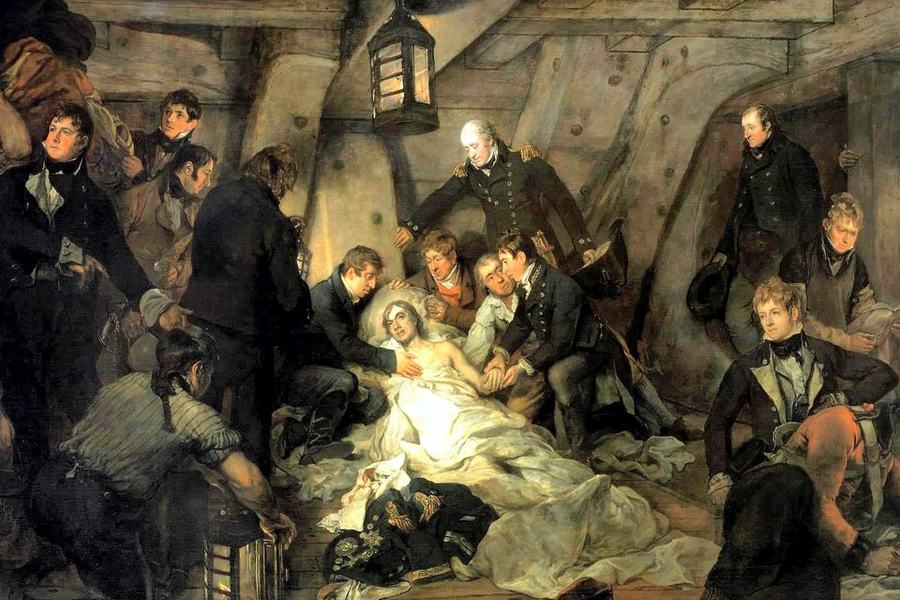
The Death of Nelson (Arthur William Devis, 1807. National Maritime Museum
Yet victory came at a terrible cost. During the battle, Nelson was shot by a French marksman from the rigging of the Redoutable. The bullet struck his shoulder and lodged in his spine. Carried below decks, he lived long enough to learn that the battle had been won. His reported final words included expressions of duty, faith, and affection. Nelson died aboard HMS Victory, at the height of his fame, having secured one of the most important naval victories in British history.
Nelson’s body was returned to Britain and given a state funeral. He was buried in St Paul’s Cathedral, an honour reserved for the nation’s greatest figures. In the years that followed, his memory became central to British naval identity. Nelson’s Column in Trafalgar Square, London, remains one of the most famous monuments in the United Kingdom. HMS Victory, preserved at Portsmouth, continues to serve as a powerful symbol of the age of sail and of Nelson’s leadership.
The legacy of Lord Horatio Nelson lies not only in his victories but in his style of command. He trusted his captains, encouraged initiative, and created what became known as the “Band of Brothers.” He understood that morale, confidence, and shared purpose could be as important as guns and ships. Nelson was not a flawless man. He was ambitious, emotional, and at times reckless. His private life invited criticism, and his pursuit of glory was intense. Yet his achievements at sea changed the course of history.
As Vice-Admiral of the Royal Navy, Nelson helped ensure that Britain remained safe from invasion and able to project power across the oceans. His victories at the Nile, Copenhagen, and Trafalgar were not isolated moments of heroism but part of a career built on experience, courage, and relentless determination. More than two centuries after his death, Nelson remains the enduring image of British naval greatness: wounded but unbroken, bold in battle, beloved by his sailors, and forever linked with the command of the sea.