HMS Belfast (C35)
HMS Belfast: builder, dates, armament, propulsion, service career and fate.
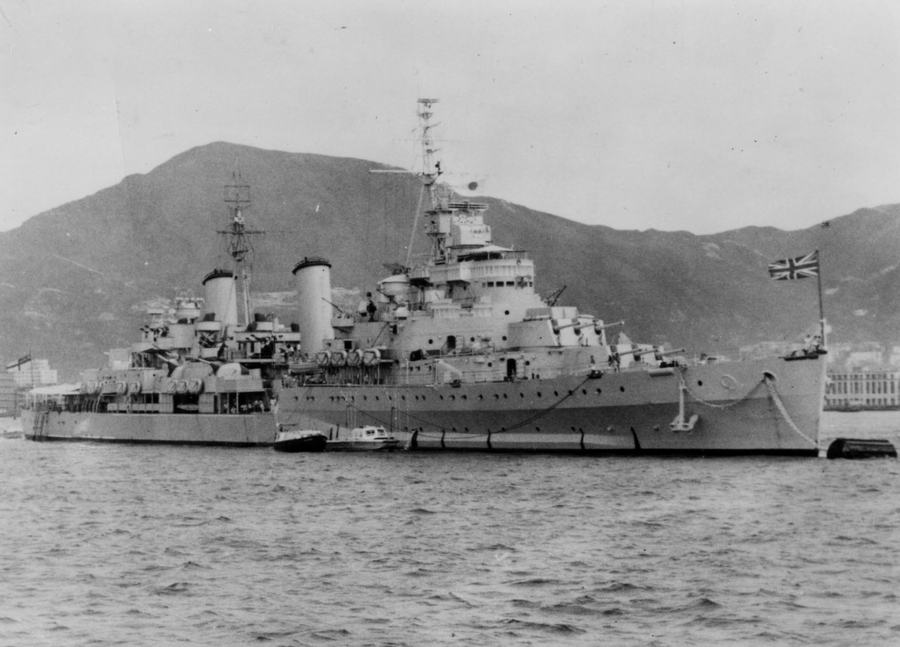
HMS Belfast (C35) on buoy
HMS Belfast is one of the most recognisable surviving warships of the Royal Navy: a Town-class light cruiser, launched in 1938, commissioned in August 1939, damaged almost immediately by a German magnetic mine, restored and modernised, then sent into some of the hardest naval service of the Second World War. She fought through the Arctic convoy campaign, helped bring the German battlecruiser Scharnhorst to destruction at the Battle of North Cape, supported the Normandy landings, served in the Far East, fought again during the Korean War, and later became a preserved museum ship on the River Thames. Her story is not only the story of a cruiser. It is also a record of British naval design, industrial effort, wartime endurance, Cold War adaptation, and the lives of hundreds of men who worked, slept, fought, repaired, watched, cooked, signalled, steered and served inside her steel hull. Imperial War Museums describes her as a ship whose visitors can now explore the stories of the hundreds of people who lived and served aboard her.
HMS Belfast was built at the Harland & Wolff shipyard in Belfast, one of the great industrial centres of British and Irish shipbuilding. She was the first Royal Navy ship to carry the name of Northern Ireland’s capital city. Her construction began in December 1936, and she was launched on Saint Patrick’s Day, 17 March 1938. In that public ceremony lay a strong symbolic connection between the ship, the city, and the industrial workforce that created her. Belfast was one of the Edinburgh sub-group of the Town-class cruisers, vessels designed to serve the Royal Navy in a world where maritime power still depended on trade protection, scouting, fleet support and the ability to project imperial strength across oceans.
She was commissioned on 5 August 1939, less than a month before Britain entered the Second World War. Her timing could hardly have been more dramatic. The ship had been designed in the troubled 1930s, when naval treaties, economic caution and the growing threats from Germany, Italy and Japan shaped every naval decision. She emerged as a large light cruiser: not a battleship, not a carrier, but a fast, heavily armed surface combatant intended to operate with fleets, protect convoys, hunt enemy raiders and use her guns against surface, air and shore targets. Her main armament of twelve 6-inch guns in four triple turrets gave her powerful broadside fire for a cruiser. Her secondary and anti-aircraft weapons, torpedoes, aircraft facilities and later radar equipment reflected the Royal Navy’s attempt to build ships that could survive in a changing naval war.
When war came in September 1939, Belfast’s first task was part of the British naval blockade against Germany. The Royal Navy’s mission was to restrict German maritime trade, intercept suspicious shipping and control the sea routes through which war material might pass. For a new cruiser, this was an expected role. But Belfast’s early war service was abruptly cut short. On 21 November 1939, while operating in the Firth of Forth, she detonated a German magnetic mine. The explosion did not sink her, but it caused severe structural damage. Her hull was badly strained, machinery was affected, and for a time there were doubts about whether the young cruiser would be worth repairing at all. Imperial War Museums notes that her war service came to a premature stop when she struck the mine in November 1939.
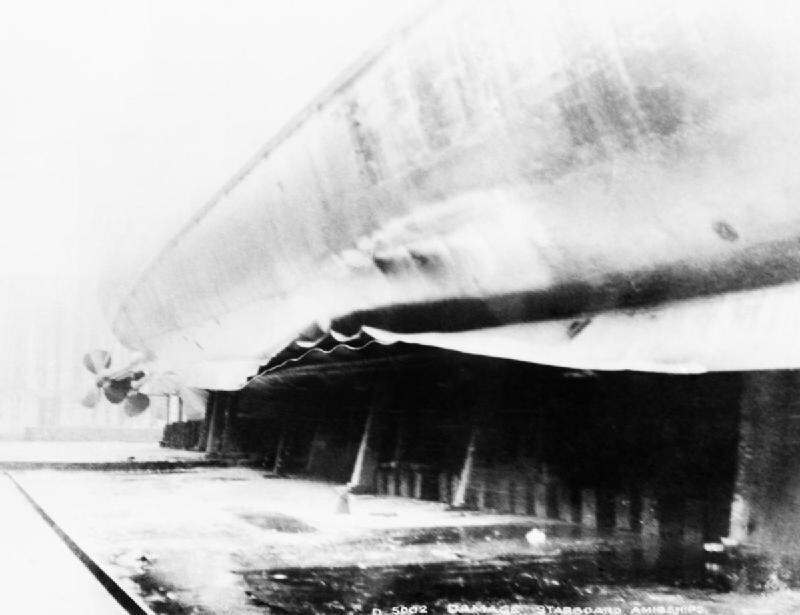
HMS Belfast (C35) damage to hull by a mine.
The mining of Belfast was an important moment in British naval experience. Magnetic mines were one of the early technological shocks of the war at sea. They did not require contact with a hull in the traditional way; they could be triggered by a ship’s magnetic field. The damage to Belfast showed how dangerous these weapons could be even in home waters. Yet the decision to repair her proved wise. Over more than two years she was not simply restored but substantially modernised. Her hull was strengthened, her internal arrangements improved, armour and protection were revised, and she received more advanced radar and fire-control equipment. By the time she returned to the fleet, she was not just a repaired ship. She was a better warship than the one that had been mined in 1939.
Belfast recommissioned in November 1942 and joined the Home Fleet at Scapa Flow. On Christmas Day 1942 she arrived under Captain Frederick Parham to join the 10th Cruiser Squadron, beginning the most famous period of her wartime career. Scapa Flow, in the Orkney Islands, had long been one of the Royal Navy’s great northern anchorages. From there Belfast would be drawn into the brutal Arctic convoy campaign, a theatre in which weather could be as dangerous as the enemy.
The Arctic convoys carried war supplies from Britain and North America to the Soviet Union. Their routes led through freezing waters toward Murmansk and Archangel, often under the threat of German aircraft, U-boats, destroyers and heavy surface ships based in occupied Norway. These convoys were strategically vital because they helped sustain the Soviet war effort at a time when Germany remained heavily engaged on the Eastern Front. They were also among the harshest operations undertaken by Allied sailors. Ice formed on decks and superstructures. Men worked in darkness, snow, spray and bitter cold. Ships had to maintain station in terrible seas while remaining alert for torpedoes, bombs and surface attack. Imperial War Museums records that Belfast and her crew spent 18 punishing months supporting the Arctic convoys.
Belfast’s role in these operations was to provide cruiser cover: protection against enemy surface ships and support for the wider escort force. Her radar was crucial. In the Arctic darkness, where visibility could vanish and daylight might be brief or absent, radar changed the balance of naval combat. Belfast could detect and track enemies beyond visual range and help coordinate the movements of the squadron. Her modernisation after the mine damage had therefore prepared her for precisely the sort of technical war that the Arctic demanded.
The climax of Belfast’s Arctic service came at the Battle of North Cape on 26 December 1943. The German battlecruiser Scharnhorst had sortied from Norway to attack convoy JW 55B, bound for the Soviet Union. Scharnhorst was fast, heavily armed and dangerous; if she reached the convoy, she could have caused devastation. The British plan relied on covering forces placed to intercept her. Belfast, as part of the 10th Cruiser Squadron under Rear-Admiral Robert Burnett, played a central role in the first contact and subsequent shadowing of the German ship.
The battle unfolded in darkness, snow and confusion. Belfast and the cruisers HMS Norfolk and HMS Sheffield engaged Scharnhorst, helped prevent her from reaching the convoy, and used radar to maintain contact. Belfast’s role as a radar shadowing ship was especially important. By keeping track of the German ship after the initial encounter, the British force helped bring Admiral Sir Bruce Fraser’s battleship HMS Duke of York into position. The resulting action ended with Scharnhorst sunk and almost her entire crew lost. Imperial War Museums highlights Belfast’s notable role in the Battle of North Cape, which ended with the sinking of Scharnhorst and the survival of only 36 of her 1,963 crew.
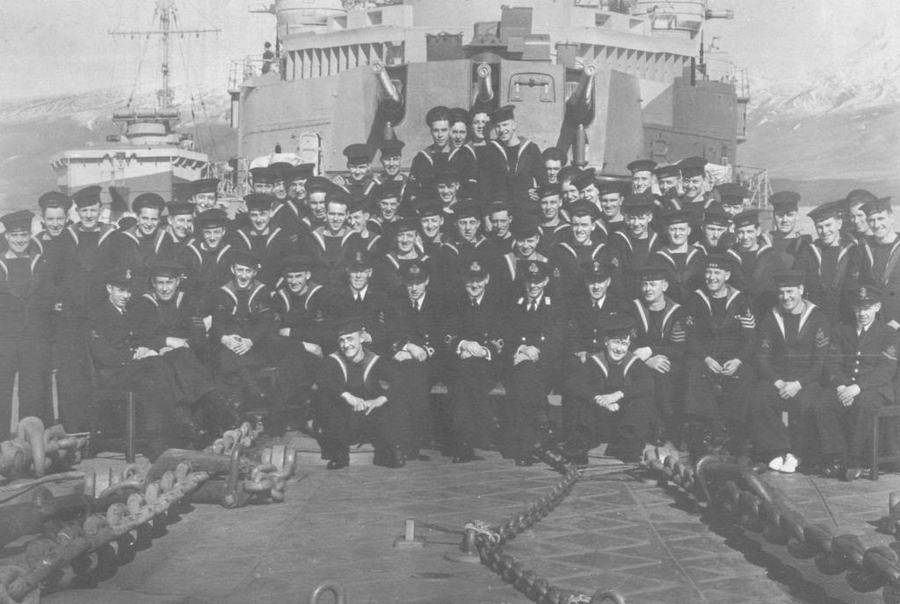
HMS Belfast (C35) ship's company
North Cape was one of the last major battleship actions in European waters, and Belfast’s part in it demonstrates the changing character of naval warfare. Guns still mattered. Heavy armour still mattered. But radar, coordination, intelligence and night-fighting skill mattered just as much. Belfast was not the ship that delivered the final destruction alone, but she was essential to the chain of detection, engagement and control that made the destruction possible. Her operations room, radar teams, gunnery crews, bridge staff and communications ratings all formed part of that achievement.
After North Cape, Belfast continued to serve on Arctic duties until 1944. By then the war was moving toward a decisive Allied return to Western Europe. Belfast was assigned to Operation Overlord, the invasion of Normandy. For D-Day, 6 June 1944, she became part of the naval bombardment force supporting the landings. Her guns, originally intended for cruiser actions at sea, now became instruments of shore bombardment. She fired on German positions threatening the landing beaches, helping suppress coastal batteries and strongpoints. Imperial War Museums notes that Belfast spent five weeks supporting the D-Day landings and reportedly fired one of the first naval shots on D-Day itself.
The Normandy role was very different from the Arctic convoy role. In the north, Belfast’s crew had watched for enemy ships and aircraft in frozen seas. Off Normandy, they supported an immense amphibious operation involving landing craft, minesweepers, destroyers, battleships, cruisers, aircraft and troops going ashore under fire. Naval gunfire support required accuracy, communication with shore observers, careful ammunition handling and sustained discipline. The ship’s guns had to fire not at visible enemy warships but at land targets, often identified through reports, maps and observation. Belfast’s work helped open and hold the bridgehead through which Allied armies would move into France.
Her bombardment duties also placed strain on the ship and crew. Repeated firing shook the hull. Gun crews worked in heat, smoke and noise. Magazines, shell rooms, hoists and turrets had to function without interruption. Below decks, engineers kept steam, power and auxiliaries running. Medical staff stood ready for casualties. Cooks and supply parties maintained the daily life of a ship at action stations. The fighting reputation of a cruiser often centres on her guns, but those guns only worked because hundreds of men below and around them kept the vessel alive.
By 1945, Belfast was sent east to join the war against Japan. She reached the Far East in the final months of the conflict, arriving too late to play the sort of major combat role she had played in European waters. Nevertheless, her deployment reflected the continuing value of large cruisers in imperial and global naval strategy. The Royal Navy expected to be present in Asian waters after Germany’s defeat, and Belfast was part of that redeployment of naval power. The atomic bombings of Hiroshima and Nagasaki and Japan’s surrender changed the immediate need for further operations, but Belfast remained useful in the post-war settlement and in the reassertion of British naval presence.
After the Second World War, Belfast did not simply disappear into reserve. She continued to serve as the Royal Navy adjusted to a changed world. The British Empire was contracting, the Cold War was beginning, and the Navy had to manage shrinking resources while maintaining global commitments. Belfast, still a large and capable cruiser, served in overseas stations and training roles. Her weapons and equipment were updated, but the basic fact remained that she belonged to a generation of gun cruisers whose original world was passing. Aircraft carriers, submarines, missiles and jet aircraft increasingly defined naval thinking. Yet in conflicts requiring visible presence and shore bombardment, ships like Belfast still had value.
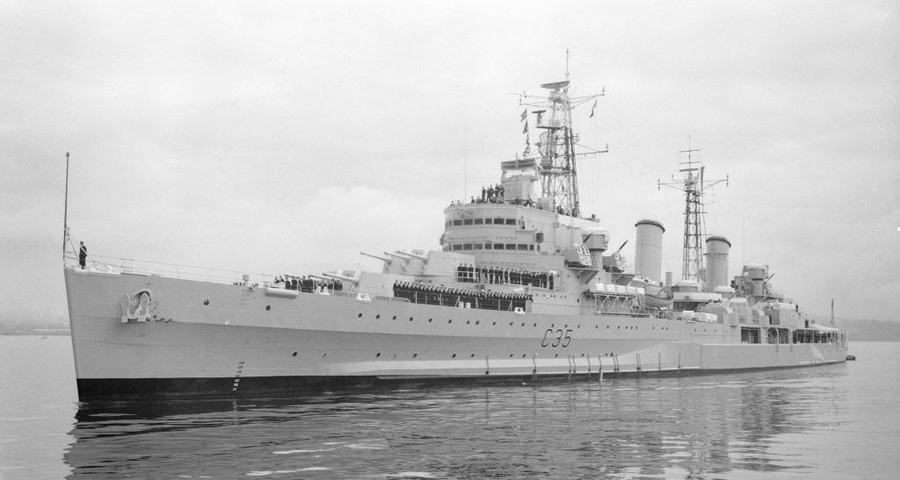
HMS Belfast (C35) port bow view
That value became clear during the Korean War. Belfast served off Korea as part of United Nations naval forces. Her main duties included coastal bombardment, patrol, support of troops ashore and the disruption of enemy communications and positions. The Korean War was a hard reminder that naval gunfire remained relevant in limited wars. Against coastal targets, supply routes and troop concentrations, a cruiser’s guns could deliver sustained fire without requiring air superiority at every moment. Royal Navy accounts continue to emphasise Belfast’s Korean War service as part of her wider combat history.
The Korean service was also a human experience remembered by those who served aboard. Imperial War Museums preserves veterans’ memories, including those of Ron Yardley, who served during the Korean War and recalled being thrown around in his hammock when the ship’s guns fired. Such memories matter because they restore scale to the ship. Belfast was not an abstract symbol.
She was a moving industrial town of steel, steam, cordite, oil, sweat and routine. When the guns fired, the whole ship felt it. When the sea was rough, hammocks swung and mess decks shifted. When the ship went to action stations, each man had a place, a duty and a risk.
From 1956 to 1959 Belfast underwent a major modernisation. This refit altered her appearance and capabilities for the post-war era. Her bridge and superstructure were changed, new radar and fire-control equipment were fitted, and living conditions were improved. The modernisation reflected a familiar Royal Navy problem: how to preserve the usefulness of existing hulls in a rapidly changing technological environment. Belfast was too valuable simply to discard, but she had to be adapted if she was to remain credible. The result was a ship that still carried the heritage of the 1930s cruiser but looked and functioned increasingly like a Cold War vessel.
Her final active years included further overseas commissions, training duties and representation of British naval power abroad. But by the early 1960s, the age of the big gun cruiser in Royal Navy service was nearing its end. Missiles, aircraft and nuclear submarines were reshaping fleet priorities. Belfast was placed in reserve in 1963. At that point, her future was uncertain. Many warships, even famous ones, ended their lives at the breaker’s yard. Steel was valuable, maintenance was expensive, and sentiment rarely saved ships without determined organisation behind it.
The movement to preserve Belfast began in the later 1960s. The argument for saving her was strong. She was a major survivor of the Second World War, a veteran of North Cape, Normandy and Korea, and an unusually complete example of a large Royal Navy cruiser. A committee involving Imperial War Museums, the National Maritime Museum and the Ministry of Defence examined whether preservation was practical. Although the government initially decided against preservation in 1971, campaigners formed the HMS Belfast Trust. Their efforts succeeded, and the ship was transferred to the Trust in July 1971. She was brought to London and moored on the Thames near Tower Bridge, opening to the public in October 1971. She became part of Imperial War Museums in 1978.
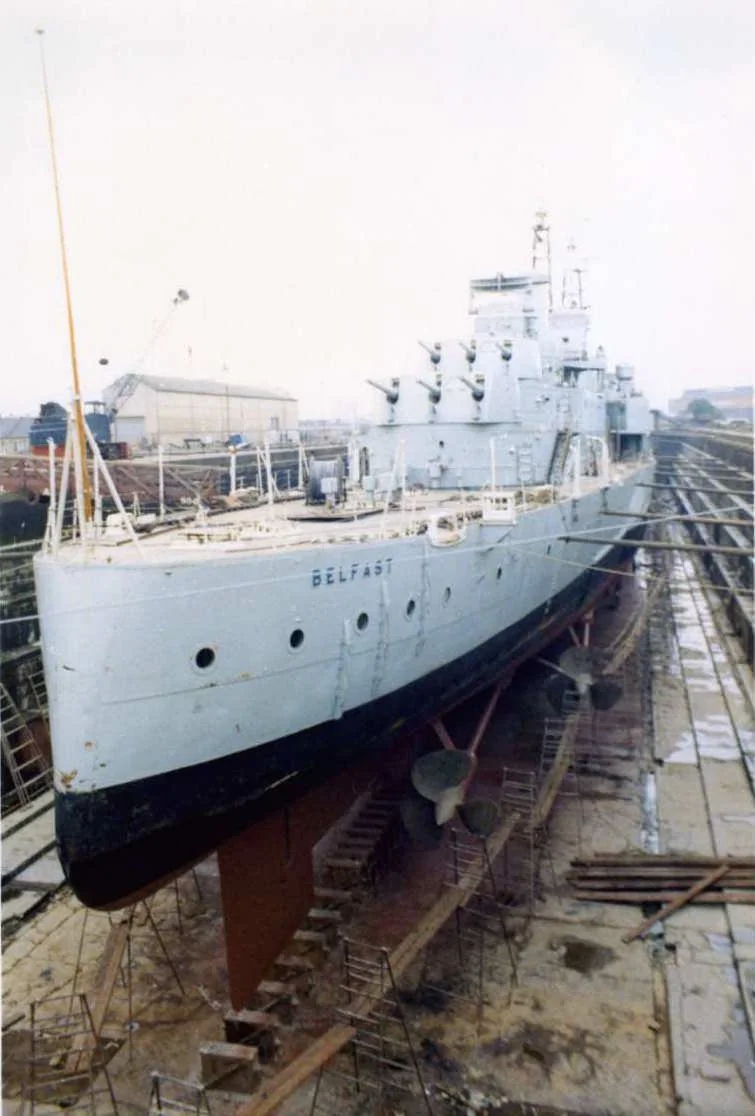
HMS Belfast (C35) in dry dock
Her preservation changed her role once again. She was no longer a fighting ship, but she remained a naval instrument: now an instrument of memory, education and public history. Visitors could walk through mess decks, engine spaces, magazines, operations rooms, galleys, sick bay and gun turrets. The ship made visible the scale and complexity of naval life. A preserved tank or aircraft can show one aspect of war; a preserved cruiser shows an entire society afloat. Belfast contains spaces of command, violence, machinery, care, religion, food, discipline and rest. She allows visitors to understand that naval warfare was not only fought on open bridges and gun decks but also in boiler rooms, plotting rooms, wireless offices, dental surgeries and cramped sleeping spaces.
As a museum ship, Belfast also carries the memory of the shipbuilders and dockyard workers who shaped her. Harland & Wolff gave her form. Devonport and other naval establishments repaired, altered and sustained her. The mine damage of 1939, the refits that followed, the post-war modernisation and the later preservation work all belong to the ship’s industrial biography. Belfast is therefore a record of labour as much as combat: riveters, welders, draughtsmen, electricians, engineers, painters, armourers and shipwrights all contributed to her long life.
Today, HMS Belfast’s presence on the Thames can make her seem inevitable, as though she was always destined to become a monument. Her history suggests otherwise. She survived by chance, repair, utility and advocacy. She might have been lost to a mine in 1939. She might have been sunk in Arctic waters. She might have suffered fatal damage off Normandy or Korea. She might have been scrapped in the 1960s or 1970s. Instead, she survived each transition: from new cruiser to damaged hulk, from repaired warship to Arctic veteran, from bombardment ship to Korean War cruiser, from reserve vessel to museum.
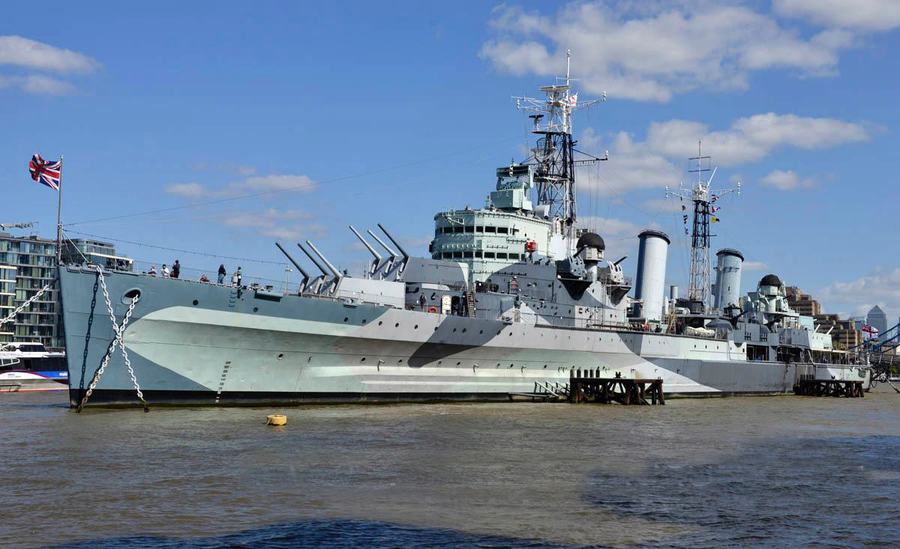
HMS Belfast (C35) in London today
Her significance lies in that continuity. HMS Belfast connects several naval worlds. She belongs to the treaty-cruiser era of the 1930s, the radar-directed night actions of the Second World War, the Arctic convoy struggle, the Normandy invasion, the imperial redeployments of 1945, the limited-war bombardments of Korea, the Cold War modernisation of old hulls, and the late twentieth-century movement to preserve historic warships. Few surviving ships carry such a broad story.
The ship also forces a more human understanding of naval history. The men who served in her were not merely attached to famous events. They endured cold, fear, boredom, noise, danger and fatigue. They learned the routines of watches, drills, cleaning, maintenance and action stations. They saw shipmates wounded or killed, heard the thunder of their own guns, and felt the vulnerability of steel in minefields, air attack and icy seas. Their experiences give Belfast her deepest meaning. The ship is impressive because of her guns and armour, but she is historically important because of the people who made those guns and armour matter.
HMS Belfast remains, therefore, one of the most valuable surviving witnesses to Royal Navy history. She is a warship, a workplace, a memorial and a museum. Her steel contains the story of a city that built her, a navy that fought her, enemies she faced, convoys she protected, soldiers she supported, crews who served inside her, and generations who later worked to save her. From the slipways of Belfast to the Arctic darkness, from North Cape to Normandy, from Korea to the Thames, her life traces the passage of Britain through war, empire, austerity, memory and preservation. She survives not simply because she is old, but because her career explains so much about the twentieth-century Royal Navy: its reach, its endurance, its industrial base, its technical adaptation and its dependence on the ordinary courage of those who served at sea.