HMS Dreadnought (1906)
HMS Dreadnought: builder, dates, armament, propulsion, service career and fate.
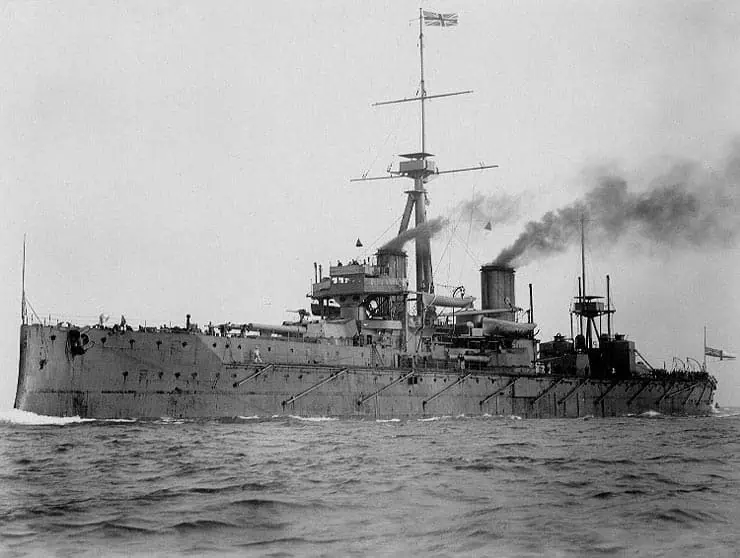
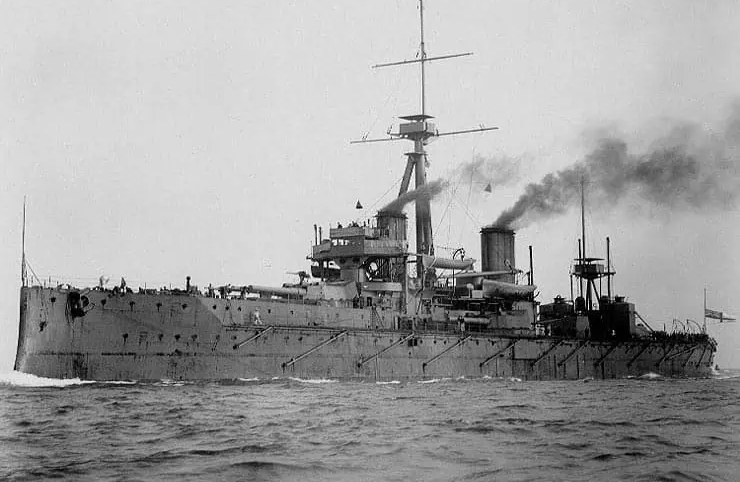
HMS Dreadnought in 1906 at sea.
HMS Dreadnought was one of the most consequential warships ever built. She did not win a Trafalgar, fight a Jutland duel, or leave behind a dramatic battle record like HMS Hood or HMS Belfast. Her importance lay in something more fundamental: she changed the measure by which modern battleships were judged. Launched in 1906, Dreadnought combined an “all-big-gun” main armament with steam turbine propulsion, giving the Royal Navy a ship that could outgun and outrun existing battleships. Royal Museums Greenwich describes her as the best-armed and fastest battleship in the world when completed, noting that her ten 12-inch guns made existing battleships obsolete and that her turbine machinery gave her a top speed of 21 knots.
Dreadnought’s name became a category. Battleships built before her were retrospectively called “pre-dreadnoughts”; ships built in imitation of her were “dreadnoughts”; later, larger and more powerful ships became “super-dreadnoughts.” Few vessels in naval history have given their name so completely to an era. She was not the first battleship to carry heavy guns, nor the first to be fast, nor the first ship to use turbines, but she brought these ideas together in a way that forced every major navy to reconsider its fleet. Royal Museums Greenwich states that she revolutionised battleship design for more than a generation and was superior in both firepower and speed to anything then afloat.
The origins of Dreadnought lay in the restless reforming energy of Admiral Sir John Fisher, who became First Sea Lord in 1904. Fisher believed that the Royal Navy had to be modern, ruthless in its priorities, and willing to abandon older assumptions. The late nineteenth-century battleship carried a mixed battery: a few heavy guns, several intermediate guns, and numerous smaller weapons. This arrangement made sense when battle ranges were expected to be relatively short. But by the early twentieth century, advances in fire control, rangefinding, armour, shell power and naval gunnery suggested that future battles might be fought at longer distances. At those ranges, the heavy gun mattered most.
The mixed battery created a practical problem. If different calibres were firing at the same target, the splashes from their shells could be difficult to distinguish. Accurate long-range fire depended on spotting shell splashes, correcting aim and firing salvos. A uniform heavy battery simplified that process. Dreadnought’s main armament of ten 12-inch guns, mounted in five twin turrets, therefore represented more than brute force. It represented a fire-control philosophy: fewer types of shell, heavier individual hits, and a ship designed around decisive long-range gunnery.
Her builder was HM Dockyard, Portsmouth, one of the Royal Navy’s principal state shipyards. Dreadnought was laid down on 2 October 1905, launched on 10 February 1906, and commissioned in December 1906. The speed of her construction became part of her legend. Royal Museums Greenwich records that she was built at Portsmouth in 14 months, a record never equalled. This rapid building was not only an industrial achievement but a strategic signal. Britain wanted rivals to understand that it could design, build and commission a revolutionary capital ship with extraordinary speed.
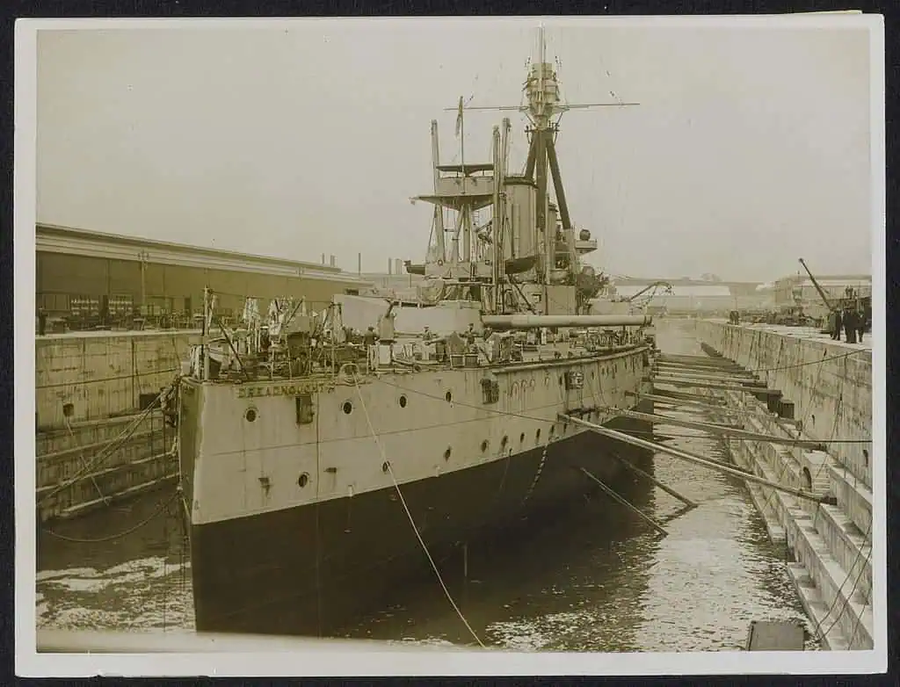
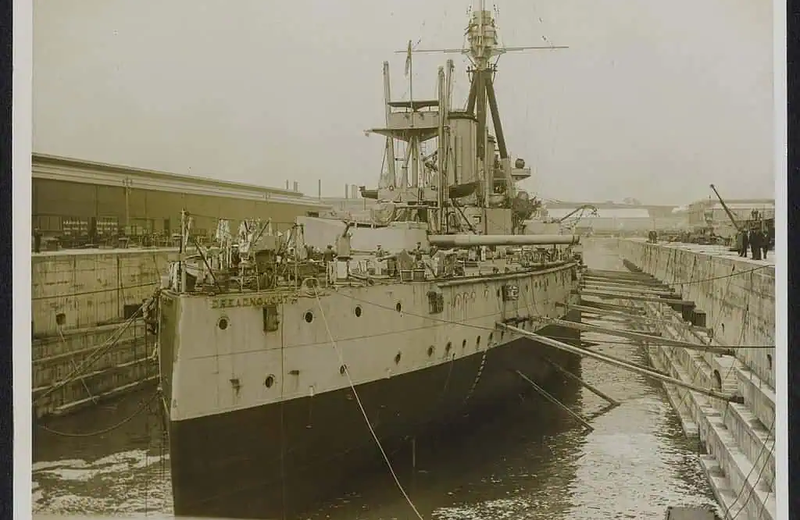
H.M.S. Dreadnought in dry dock.
The social and industrial story behind Dreadnought is therefore central to her meaning. Portsmouth Dockyard was not simply a place where steel was assembled. It was a vast naval-industrial community of shipwrights, engineers, draughtsmen, boilermakers, riveters, armourers, electricians, pattern-makers, clerks, inspectors and naval overseers. The ship’s creation depended on dockyard discipline, state planning, private contractors and specialist manufacturers. Vickers, Sons & Maxim was the prime contractor for the machinery, while Parsons supplied the turbines. Dreadnought was the product of a national naval system: Admiralty policy, dockyard capacity, industrial skill and political urgency fused into one hull.
Her machinery was as revolutionary as her armament. Earlier battleships normally used reciprocating engines, large piston machinery that had powered warships through the late Victorian and Edwardian periods. Dreadnought used steam turbines. These were lighter, smoother-running and capable of sustained high speed. She was fitted with 18 Babcock & Wilcox boilers, two sets of steam turbines, four shafts, and machinery rated at about 23,000 shaft horsepower.
During trials she exceeded her designed speed, reaching more than 21 knots. This made her faster than the ordinary battleships she rendered obsolete.
The adoption of turbines involved risk. Turbine propulsion in capital ships had not yet been fully proven on this scale. But Fisher and the Admiralty recognised that speed was not a luxury. A battleship that could choose range, overtake slower enemies and evade unfavourable action possessed tactical advantage. Dreadnought could not only hit harder than earlier battleships; she could also move faster. That combination created the shock.
Her armour and layout reflected the compromises of the period. Dreadnought was powerfully protected but not invulnerable. Her main belt, turrets, barbettes and armoured decks were designed to withstand contemporary gunfire, while longitudinal bulkheads helped protect magazines and shell rooms from underwater explosions. Her secondary armament of 12-pounder guns was intended mainly for defence against torpedo craft, which were a growing threat to battleships. She also carried torpedo tubes, reflecting the fact that even the most modern battleship still belonged to a naval world where close-range attack remained a concern.
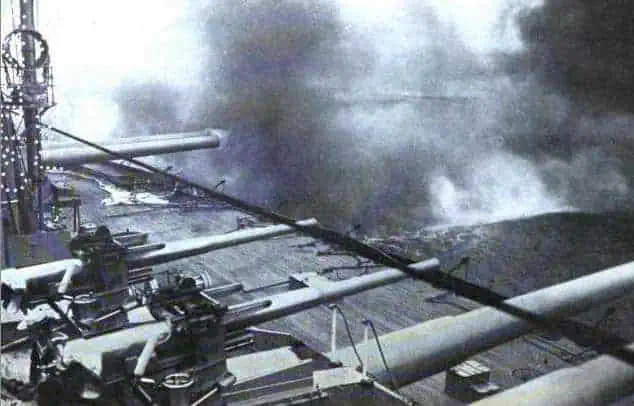
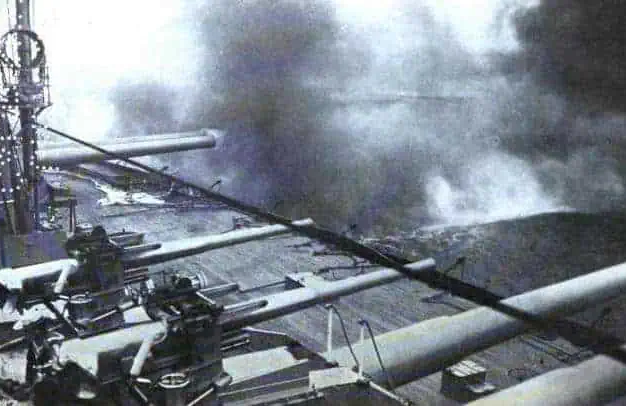
H.M.S. Dreadnought firing a broadside.
Dreadnought’s appearance was imposing but not ornate. She had a purposeful silhouette, with heavy turrets arranged to give strong broadside fire. Her layout was not perfect: only eight of her ten heavy guns could normally fire on one broadside, and blast effects limited some firing arcs. But these details mattered less than the overall transformation she embodied. She carried a uniform heavy battery, turbine machinery, modern fire-control thinking and the prestige of being first.
When she entered service, the consequences were immediate and paradoxical. Britain had built the world’s most powerful battleship, but by doing so it had also made much of its own existing battle fleet obsolete. The Royal Navy possessed a large number of pre-dreadnought battleships, but after 1906 those ships were no longer first-class units.
The same was true of foreign fleets. Dreadnought reset the race. Naval strength could no longer be measured simply by counting battleships; one had to ask whether they were dreadnoughts or pre-dreadnoughts.
This helped intensify the Anglo-German naval rivalry. Germany had already been building a battle fleet under Admiral Alfred von Tirpitz, and Britain viewed that fleet as a direct challenge in the North Sea. Dreadnought did not create the rivalry by herself, but she altered its terms. All major naval powers now wanted dreadnought-type ships. Britain, which had long enjoyed numerical superiority in battleships, had to ensure that it also led in the new category. The naval arms race became a contest in dreadnought construction, dockyard capacity, gun production, armour manufacture, finance and political will.
Dreadnought’s own service career was less dramatic than her design career. She was initially flagship of the Home Fleet and became a symbol of British naval modernity. In peacetime she trained, exercised, hosted inspections and helped develop tactics for the new generation of capital ships. Her crew lived within a machine that was both experimental and prestigious. A complement of roughly 700 men in her early years, rising later during wartime, had to operate boilers, turbines, guns, magazines, fire-control equipment, signalling systems, steering gear, boats, pumps, workshops, wireless spaces and the ordinary domestic machinery of naval life.
Life aboard was demanding. A battleship was a floating industrial settlement. Men slept in hammocks or crowded mess spaces, kept watches, cleaned paintwork and brass, coaled ship, maintained weapons, drilled at action stations and endured the noise and heat of machinery spaces. Coal-fired boilers meant hard physical labour. Dreadnought also carried oil to spray on coal and increase its burn rate, but she remained part of the coal-fired age. Coaling ship was filthy, exhausting work, covering men and surfaces in black dust. The glamour of the all-big-gun battleship rested on the labour of stokers, trimmers, engineers, artificers and seamen whose names rarely appear in strategic histories.
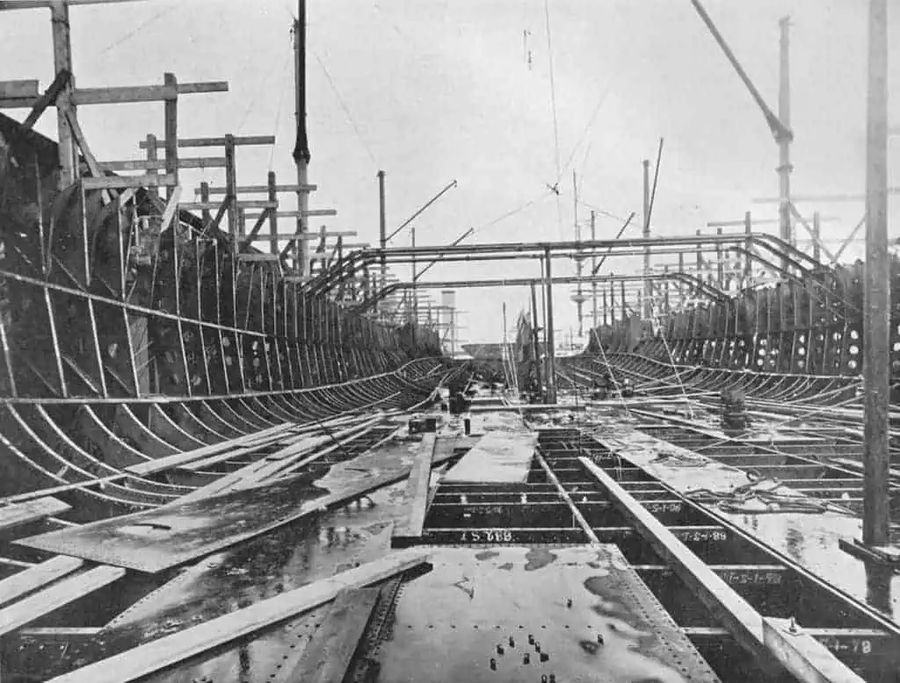
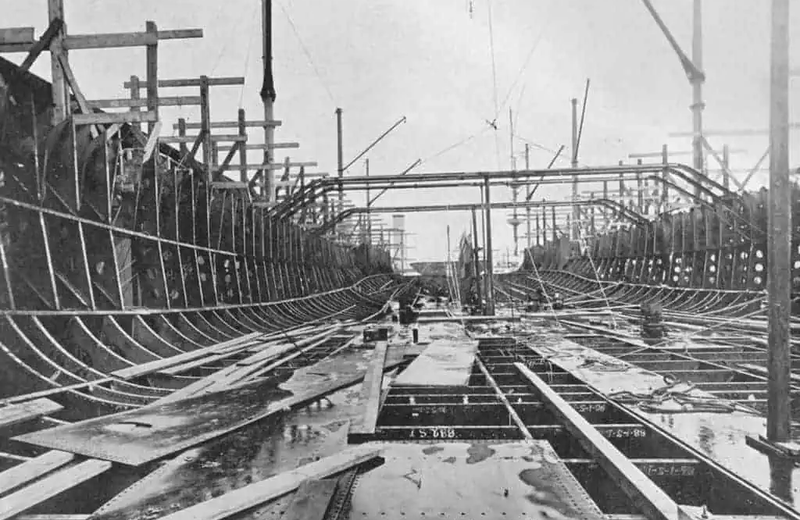
HMS Dreadnought second day after the keel being laid.
The ship’s crew also lived with the prestige of serving in a famous vessel. Dreadnought was not just another battleship. She was watched by foreign attachés, naval journalists, politicians and rival admiralties. Her performance was evidence in a global argument about naval power. Every exercise, gunnery trial and mechanical test contributed to understanding what the new type could do. The men who served in her were therefore part of a naval experiment whose results shaped fleets across the world.
By the time the First World War began in 1914, Dreadnought was already no longer the newest or most powerful battleship in the Royal Navy. This was one of the ironies of her achievement.
She had accelerated battleship development so dramatically that newer dreadnoughts and super-dreadnoughts soon surpassed her. They carried larger guns, better armour, improved fire-control systems and more refined layouts. The ship that made others obsolete was herself overtaken within a few years. Yet she remained a valuable unit.
During the First World War, Dreadnought served with the Grand Fleet, the great concentration of British naval power based mainly at Scapa Flow. The Grand Fleet’s purpose was to contain the German High Seas Fleet, protect British command of the sea, and ensure that Germany could not break out to threaten British trade and troop movements. The war at sea in the North Sea was often one of waiting, patrols, sweeps, mining, submarine danger and sudden alarms rather than constant battle. For battleship crews, the war could involve long periods of routine interrupted by moments of intense risk.
Dreadnought’s most notable wartime action came not against another battleship but against a submarine. On 18 March 1915, she rammed and sank the German submarine U-29 in the Pentland Firth. U-29 was commanded by Otto Weddigen, already famous in Germany for earlier submarine successes. Dreadnought thus became the only battleship known to have sunk a submarine by ramming. It was an unusual achievement for a ship designed around long-range heavy gunnery. Her great guns, which had transformed naval architecture, never fired in a major fleet action against an enemy battleship.
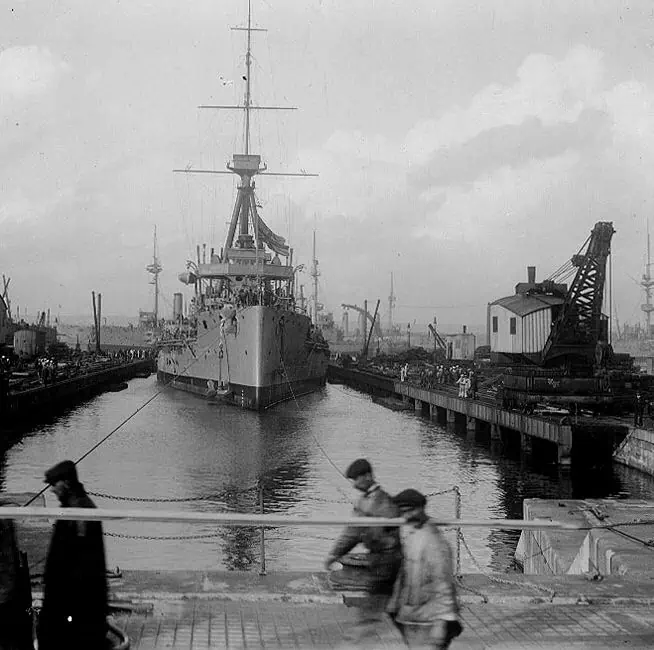
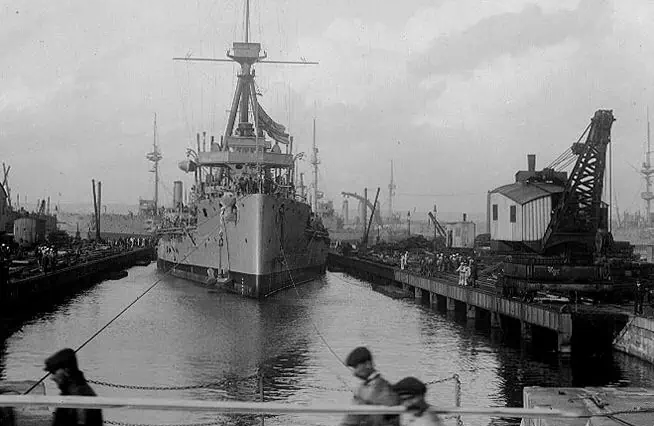
HMS Dreadnought entering dry dock.
This absence from a decisive gunnery battle has sometimes made Dreadnought seem strangely anticlimactic. She gave her name to an era of battleship rivalry, but she did not fight at Jutland in 1916, the largest battleship engagement of the war. At that time she was undergoing refit and therefore missed the battle for which ships of her type had been built. Yet this does not diminish her importance. Some warships matter because of what they do in battle; others matter because of what their existence forces everyone else to do. Dreadnought belongs decisively to the second category.
Her later wartime career reflected her declining front-line status. As newer and more powerful ships entered service, Dreadnought became less central. She served in different formations and was eventually placed in reserve.
By 1918 the first generation of dreadnought battleships was already ageing. Naval warfare had also changed in ways that Fisher had anticipated only partly. Submarines, mines, aircraft, wireless intelligence and convoy organisation had become central to maritime war. Battleships still mattered, but their freedom of action was constrained by threats that did not require an enemy battle fleet to appear over the horizon.
After the war, Dreadnought’s fate was practical rather than ceremonial. She was paid off in 1919 and sold for scrap in 1921. Unlike HMS Victory or HMS Belfast, she did not survive as a museum ship. Her material disappearance is striking given her historical importance. But post-war Britain was tired, financially strained and burdened with surplus warships. The Washington Naval Treaty era encouraged reductions in capital ships. Dreadnought, once revolutionary, had become outdated steel.
Her scrapping did not erase her influence. Every major battleship design of the early twentieth century must be understood in relation to her. The American, German, Japanese, Italian, French, Russian and later British dreadnoughts all emerged in a world she had helped create. She changed naval budgets, shipyard programmes, diplomatic calculations and public debates. Newspapers counted dreadnoughts. Politicians argued over dreadnoughts. Naval leagues demanded more dreadnoughts. Strategic anxieties were expressed in dreadnought numbers.
The ship also changed language. “Dreadnought” became a word for a type, not merely a name. That linguistic legacy is rare. It shows that contemporaries understood the ship as a dividing line. Before her, battleships were mixed-battery pre-dreadnoughts; after her, the all-big-gun capital ship became the standard. Even the rise of the aircraft carrier and submarine did not immediately erase the dreadnought idea. The great battleships of the Second World War, from HMS King George V to USS Iowa and Yamato, descended from the revolution Dreadnought began, even though they were vastly more powerful.
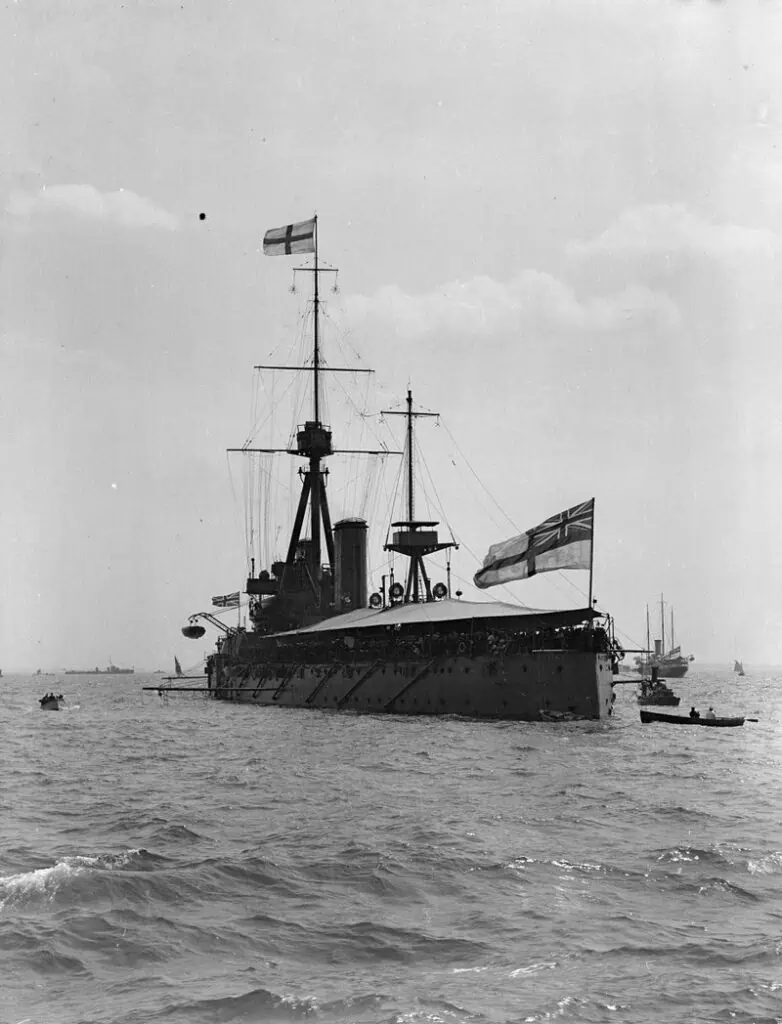
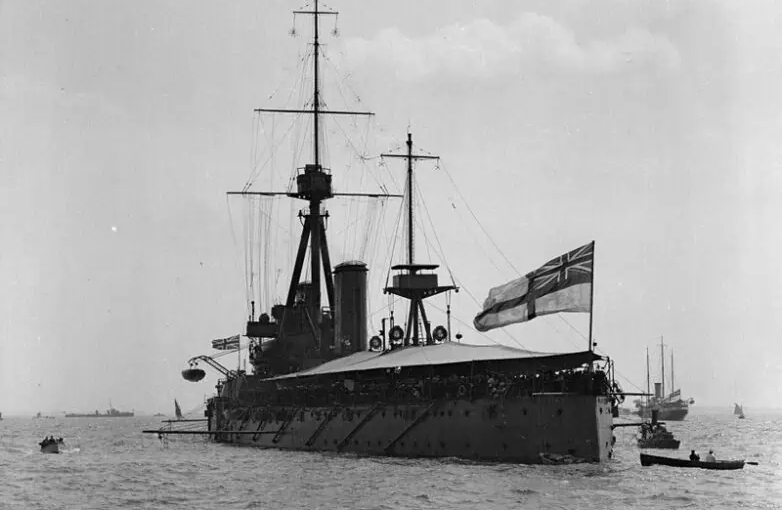
HMS Dreadnought (1906) with awning rigged, anchored in the Thames Estuary.
Dreadnought’s historical importance also lies in her contradictions. She was built to secure British superiority but made British superiority more expensive to maintain. She was a masterpiece of naval innovation but shortened the useful life of earlier British ships. She was a battleship famous for guns she never used in a great battle. She was a symbol of permanence that became obsolete with startling speed. She was a triumph of Portsmouth Dockyard and British engineering, yet she survived barely fifteen years after commissioning.
Her story also shows the relationship between technology and strategy. A new weapon or ship does not simply add capability; it changes the system around it.
Dreadnought altered fleet structure, dockyard priorities, naval diplomacy, public opinion and alliance calculations. She made older battleships politically and militarily less persuasive. She forced foreign navies to respond. She encouraged the belief that national security could be measured in modern capital ships. In that sense, she was not just a battleship but an event.
The crew who served aboard her were part of that event, though most did not become famous. They stood watches in cold seas, sweated in machinery spaces, maintained the turrets, coaled the ship, cleaned mess decks, operated wireless equipment, handled boats, cooked meals and kept the routines of the Royal Navy moving. Their ship was famous, but their service was often ordinary in the way naval service usually is: repetitive, disciplined, physical and technical. Dreadnought’s revolution depended not only on Fisher’s vision and Portsmouth’s construction but on the men who made the machinery turn and the guns ready.
In memory, HMS Dreadnought is sometimes reduced to a formula: all-big-gun armament plus turbine propulsion equals revolution. That formula is accurate, but incomplete. She was also a political statement, an industrial feat, a crewed community, a tactical experiment and a strategic shock. Her record should include her name, builder, dates, armament, propulsion and fate, but those facts open into a much larger history. HMS Dreadnought, built at Portsmouth, launched in February 1906, commissioned in December 1906, armed with ten 12-inch guns, driven by steam turbines, and sold for scrap in 1921, changed the world’s navies more profoundly than many ships that fired far more shots in anger.
Her legacy is therefore immense. She marked the moment when the old battleship order collapsed and a new one began. She showed that speed, firepower and industrial confidence could be combined in a single design so powerfully that every rival had to respond. She made the Royal Navy briefly appear more dominant than ever, while also beginning a new and costly competition. She proved that naval innovation could produce not gradual improvement but sudden obsolescence.
HMS Dreadnought’s career was not long, and her battle record was limited. Yet she remains one of the defining warships of modern history. She was the ship that turned “dreadnought” from a name into a measure of power. She was the Portsmouth-built machine that changed naval architecture, intensified arms competition, and shaped the fleets that went to war in 1914. Her steel was broken up after the First World War, but her influence endured wherever navies built fast, heavily armed capital ships. In that endurance lies her true historical significance: HMS Dreadnought did not need a long list of victories to become legendary. Her launch was itself the victory of a new idea.
HMS Dreadnought (1906)