HMS Erebus (1826)
HMS Erebus: builder, dates, armament, propulsion, service career and fate.
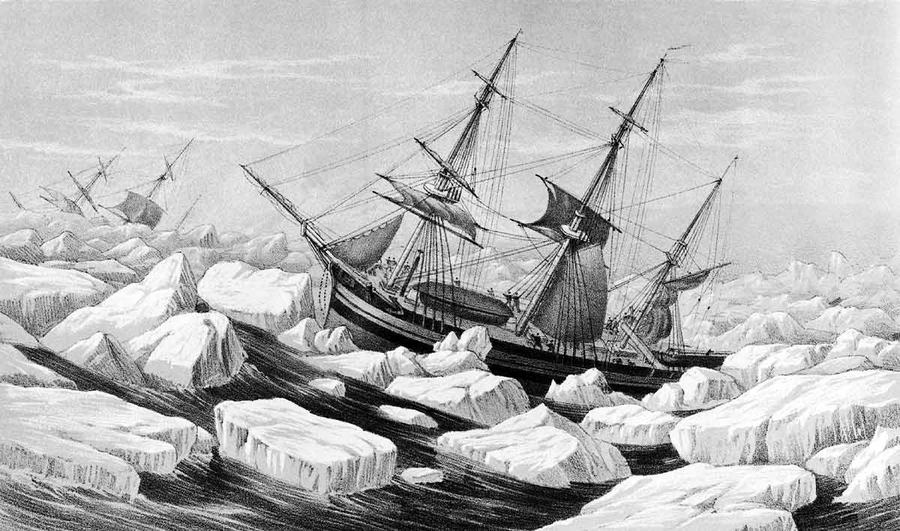
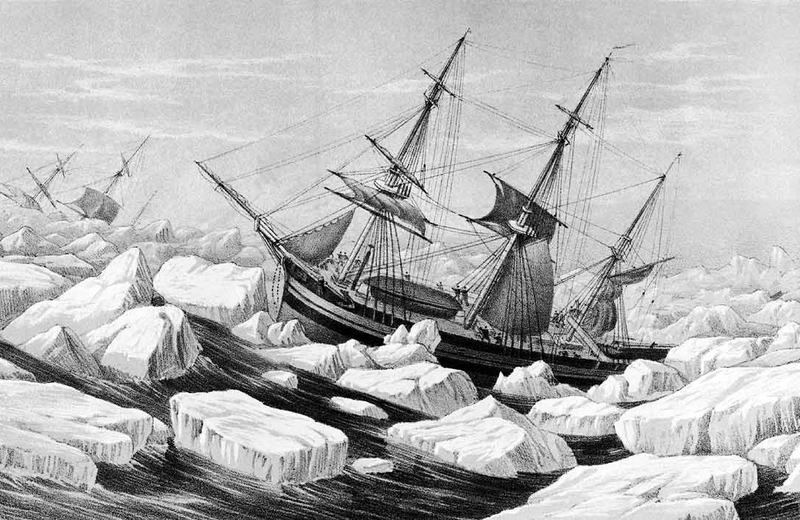
A Gale in the Pack, 20 January 1842. Engraving from A Voyage of Discovery and Research in the Southern and Antarctic Regions, during the Years 1839-43. Volume 2.", James Clark Ross, 1847.
HMS Erebus was a small ship with an immense historical afterlife. Built as a Royal Navy bomb vessel in the 1820s, she was never intended to become one of the most famous exploration ships in the world. Her original purpose was bombardment: to carry heavy mortars capable of throwing explosive shells against fortified positions. Yet her heavy construction made her suitable for another kind of danger. Like her later consort HMS Terror, Erebus was adapted for polar exploration, where thick timber, reinforced structure and stubborn endurance mattered more than speed or elegance. Her life carried her from Pembroke Dock to the Antarctic, from scientific discovery to the Arctic search for the Northwest Passage, and finally to disappearance beneath the waters of the Canadian Arctic. Her wreck was discovered in 2014 by Parks Canada in collaboration with Inuit communities, one of the most important maritime archaeological discoveries of recent times.
Erebus was a Hecla-class bomb vessel, launched at Pembroke Dockyard on 7 June 1826. Pembroke Dock was one of the Royal Navy’s significant nineteenth-century building yards, and Erebus belongs to its industrial and naval history. She was not large when compared with frigates, ships of the line or later steam warships, but her type was strongly built. A bomb vessel had to absorb the shock of firing heavy mortars. The recoil and blast placed exceptional stress on the hull, so such vessels were given broad, robust forms, strong internal framing and heavy timbering. This structural strength later made Erebus useful in ice. A ship built to endure the punishment of her own weapons could be modified to resist the pressure of polar seas.
Her name was fittingly dark. In classical mythology, Erebus was associated with darkness and the underworld. Royal Navy bomb vessels often carried severe or fiery names, reflecting their explosive role. But the name would later seem almost prophetic, because Erebus disappeared into one of the darkest mysteries of Arctic exploration. Before that, however, she had a more practical identity: she was a small, tough naval vessel in a period when the Royal Navy was moving from the world of sail and wooden warships toward steam, iron, science and global surveying.
Erebus did not achieve fame as a fighting ship. Her importance came after her conversion for exploration. The Royal Navy of the nineteenth century was more than a battle fleet. It was an agency of mapping, science, diplomacy and empire. Naval officers surveyed coasts, measured magnetism, searched for routes, charted unknown waters and carried British authority into distant regions. Old bomb vessels were useful for this work because polar exploration required endurance more than combat speed. Erebus and Terror were therefore repurposed from warlike origins into instruments of geographical ambition.
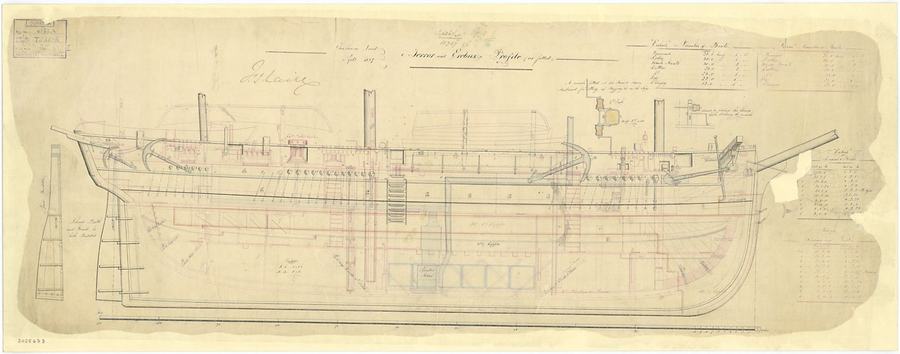
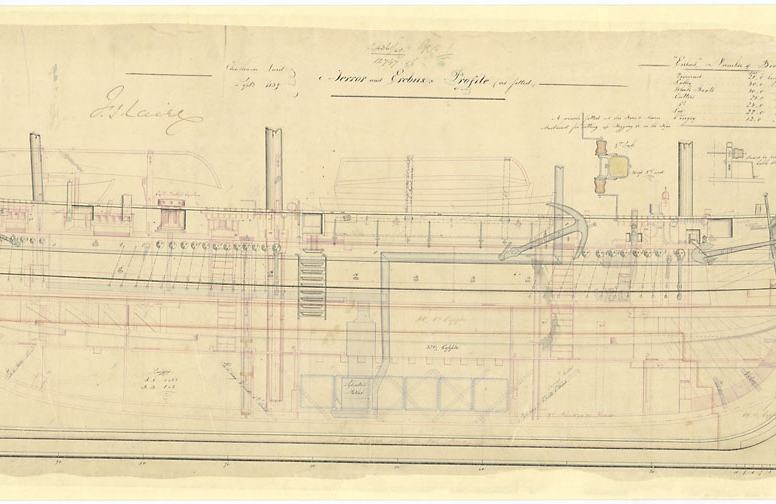
HMS Erebus (1826) drawing
The first great chapter of Erebus’s exploration career came under Captain James Clark Ross. Between 1839 and 1843, Erebus and Terror sailed on a major Antarctic expedition. Erebus was commanded by Ross, while Terror was commanded by Francis Crozier. The expedition’s aims included scientific observation, magnetic research and geographical discovery in the southern polar regions. It was one of the great naval scientific expeditions of the nineteenth century. The two ships forced their way into waters no ships had previously reached, charted coastlines, studied ice, and gave names to places still prominent on Antarctic maps. Mount Erebus, the active volcano on Ross Island, was named after the ship, while Mount Terror was named after her consort.
The Antarctic expedition showed why Erebus had been selected. Ice was not merely an obstacle; it was a force that could crush, trap or carry ships. Crews had to live with cold, darkness, isolation and uncertainty. A polar voyage was a test of hull, provisions, leadership and morale. Erebus endured the Antarctic environment and returned. That success gave her a strong reputation. She and Terror became proven polar ships, and that reputation later made them the obvious candidates for Sir John Franklin’s expedition to the Arctic.
The Antarctic voyage also established Erebus as a scientific platform. She was not simply pushing into unknown waters for glory. The expedition gathered data on magnetism, weather, geography and natural history. This reflected an age when exploration and science were closely tied to naval power. Britain’s ability to send ships into distant seas supported imperial mapping, navigational safety and national prestige. Erebus, though small, became part of that wider imperial-scientific project.
After returning from the Antarctic, Erebus was selected for an even more famous mission: the 1845 Franklin expedition in search of the Northwest Passage. For centuries, Europeans had searched for a navigable route through the Arctic connecting the Atlantic and Pacific. Such a route promised commercial and strategic advantage, though its practical usefulness was often exaggerated by hope. By the 1840s, much of the Arctic coastline had been charted, but the final route remained uncertain. The Admiralty chose Sir John Franklin to command the expedition. Franklin was an experienced explorer and naval officer, though older than many ideal expedition commanders. Erebus became his flagship; Terror sailed with her under Captain Francis Crozier. Britannica records that the expedition departed Britain on 19 May 1845, with Franklin commanding Erebus, James Fitzjames as his second-in-command, and Crozier captain of Terror.
Before departure, Erebus and Terror were heavily modified. The changes reveal the engineering imagination of the period. Their hulls were strengthened further for ice. Internal heating systems were installed. Provisions were loaded for a long voyage. Most strikingly, both ships received auxiliary steam engines adapted from railway locomotives, driving screw propellers. These engines did not make them true steamships in the later sense; coal capacity was limited, and sail remained essential. But steam offered help in calm conditions, confined waters or manoeuvring among ice. Erebus was therefore a hybrid of eras: a wooden sailing bomb vessel, strengthened for ice, fitted with auxiliary steam, and sent into a region where no machinery could guarantee success.
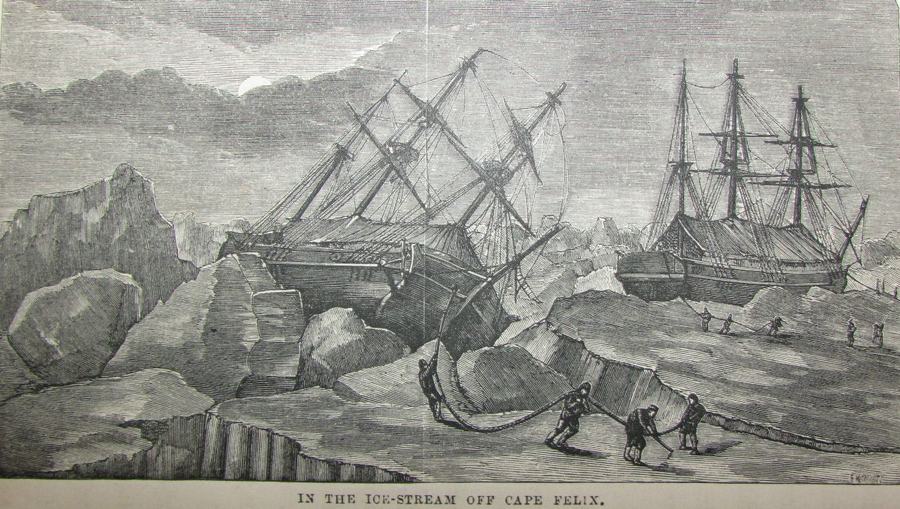
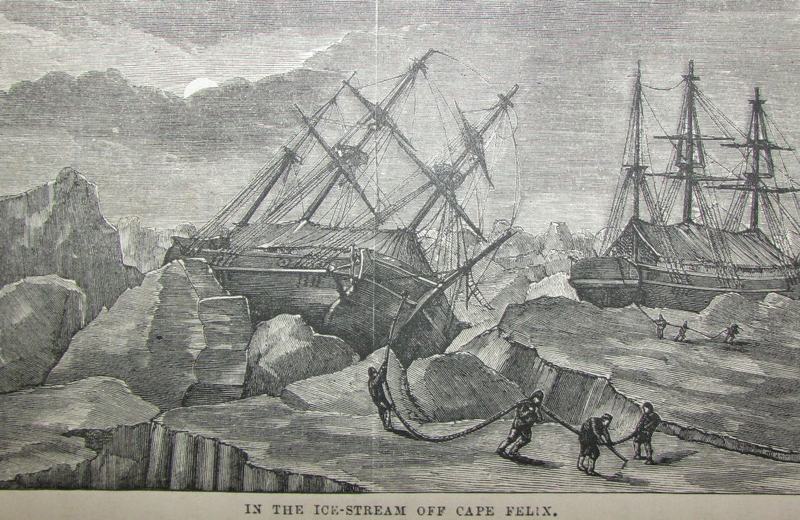
HMS Erebus and HMS Terror in the ice; The Career, Last Voyage, And Fate Of Captain Sir John Franklin. Bradbury & Evans,1860.
The ship’s internal world was crowded and complex. Erebus carried officers, seamen, Royal Marines, engineers, stokers, carpenters, cooks, stewards and specialists. Scientific instruments, preserved food, boats, clothing, weapons, books and expedition equipment filled the vessel. The crew lived within a strict naval hierarchy. Sir John Franklin commanded the expedition from Erebus, while Commander James Fitzjames served as captain of the ship and Franklin’s senior subordinate. Fitzjames was an energetic and ambitious officer with wide service experience. Recent DNA research has identified remains from the Franklin expedition as those of Fitzjames, giving a human and forensic link to a man who had long been known mainly through documents and expedition history.
Erebus and Terror sailed from Greenhithe in May 1845. They called at the Orkneys and then Greenland, where supplies were transferred and letters sent home. In late July 1845, whaling ships saw them in Baffin Bay near the entrance to Lancaster Sound. No Europeans saw them again. From that point, Erebus entered the realm of mystery. The expedition moved westward into the Arctic channels. At first, the ships appear to have made progress. They wintered at Beechey Island in 1845–1846, where three crewmen died and were buried. Later, they sailed south and west, but became trapped in ice near King William Island.
The known outline of the disaster comes from later search expeditions, Inuit testimony, archaeological finds and the famous Victory Point note. The ships were beset in ice in September 1846. Franklin died on 11 June 1847. By April 1848, the crews had abandoned Erebus and Terror. At that point, many men were already dead, and the survivors, led by Crozier and Fitzjames, planned to march south toward the Back River. None survived. Britannica notes that all 129 officers and men of Erebus and Terror perished.
The abandonment of Erebus is one of the most haunting moments in naval history. A ship is normally a sailor’s refuge. In the Arctic, Erebus had become a prison. Ice held her beyond the crew’s power to free her. The men faced hunger, cold, scurvy, disease, exhaustion and psychological collapse. They had heating, provisions, discipline and naval training, but the Arctic defeated them. When they walked away from the ships, they walked away from shelter, stores, identity and hope. The march south was an act of desperation.
The causes of the disaster have been debated for generations. Scurvy almost certainly played a role. Starvation and exposure were decisive. The quality of tinned food has been questioned, as has possible lead contamination. Poor local knowledge, overconfidence, rigid naval assumptions and the difficulty of Arctic travel all contributed. Inuit accounts described starving men, abandoned boats, bodies and signs of cannibalism. Victorian Britain struggled to accept such testimony, partly because it conflicted with heroic images of British naval discipline. Modern archaeology has confirmed that the final stages were desperate and grim. The Franklin expedition is now understood less as a clean heroic tragedy and more as a human catastrophe shaped by environment, planning failures, illness and cultural misunderstanding.
Erebus’s social history lies in those 129 men across the two ships. They were not symbols; they were individuals living under increasingly impossible conditions. Aboard Erebus were officers who kept journals and navigational records, sailors who handled rigging and boats, engineers who maintained the auxiliary machinery, stokers who managed coal and boilers, cooks who prepared meals, carpenters who repaired the ship, marines who preserved order, and medical staff who tried to manage illness. The crew’s labour held the expedition together for as long as it could. Their final silence is one reason the wrecks matter so deeply. They may still contain evidence of what the men did, ate, wrote, repaired, carried and abandoned.
For many years, the ships were missing. Their absence generated one of the largest search efforts in polar history. Beginning in 1847, British, American and later Canadian expeditions searched for Franklin. These searches mapped large areas of the Arctic, recovered relics and gathered Inuit testimony. Lady Jane Franklin, Franklin’s wife, became a relentless force in keeping the search alive. The search for Erebus and Terror ultimately produced more geographical knowledge than Franklin’s expedition itself. In that sense, the lost ships continued to shape Arctic exploration long after their crews had died.
The role of Inuit knowledge is central. Inuit witnesses and oral histories preserved information about ships, wreckage, starving men and abandoned objects. For too long, British searchers treated this knowledge selectively or dismissively. Modern searches were more successful because they took Inuit testimony seriously. Parks Canada states that Inuit knowledge provided clues about the fate of the Franklin expedition and helped search teams locate the wrecks in 2014 and 2016. The discovery of Erebus was therefore not simply a triumph of technology. It was also a vindication of Indigenous memory.
HMS Erebus was found on 2 September 2014 in Wilmot and Crampton Bay. Parks Canada’s underwater archaeology team, working with partners and informed by Inuit knowledge, located the wreck using sonar. Parks Canada records that the wreck appeared clearly on the sonar screen and was immediately recognisable as a ship. The discovery was internationally significant. One of the great lost ships of exploration had been found after nearly 170 years. In 2016, Terror was found as well, completing the physical rediscovery of Franklin’s two ships.
The wreck of Erebus lies in relatively shallow water compared with Terror, and it is more vulnerable to environmental damage. Archaeologists have recovered hundreds of objects from the wrecks of Erebus and Terror, including material that may illuminate daily life, command decisions and the expedition’s final months. Royal Museums Greenwich reported that more than 350 objects had been recovered from the wrecks by 2020. More recent reporting has stressed the urgency of archaeological work on Erebus because the wreck is exposed to increasingly severe storms and climate-related change in the Arctic.
The archaeological importance of Erebus is immense. Written records from the expedition are scarce, and no full expedition journal has been recovered. The wreck may therefore hold evidence that documents cannot supply. Objects such as medicine bottles, tools, weapons, clothing, navigation instruments, tableware, personal possessions and ship fittings can reveal how the crew lived and how the ship was used after becoming trapped. Even the position of objects may matter. A cabin, a mess area, a storage space or a boat-related item can alter interpretations of the final period.
Erebus’s wreck is also a war grave and a place of memory. The ship should not be understood merely as a treasure site or adventure object. Men died in and around these ships, and many more died after leaving them. Archaeology must balance investigation with respect. The collaboration between Parks Canada and Inuit communities reflects this more careful modern approach. The wrecks are part of Canadian Arctic heritage, Inuit historical knowledge, British naval history and the wider history of exploration.
The ship’s industrial record also deserves attention. Erebus was built at Pembroke Dock, a place whose identity remains closely connected with her. Pembroke Dock Heritage Trust describes Erebus as central to one of Pembroke Dock’s remarkable stories, noting that she was built in the town’s Royal Dockyard and that her adventures helped shape the map of the known world. The ship’s life connects a Welsh dockyard community to Antarctic volcanoes, Arctic wreck sites and global maritime memory. Her construction was not glamorous in the way later battleship launches were glamorous, but it was skilled, practical and lasting.
Her design history is a story of adaptation. As built, Erebus was a bomb vessel of around 370 tons, strongly constructed to carry mortars. She was later strengthened for polar work, altered internally for long voyages, and fitted with auxiliary machinery. Each conversion changed her identity. She began as a weapon for attacking fixed positions. She became a scientific platform in the Antarctic. She then became a hybrid exploration vessel searching for a commercial-geographical route through the Arctic. Her hull carried the marks of these changes. Few ships of her size have lived so many historical lives.
Erebus’s Antarctic career should not be overshadowed entirely by Franklin’s disaster. Under Ross, she helped expand geographical and scientific knowledge of the southern polar region. The naming of Mount Erebus gives the ship a permanent place on the Antarctic map. Her voyage with Terror showed that careful naval organisation, strong ships and experienced polar leadership could achieve remarkable results. That success helps explain why the Admiralty trusted the ships again. The tragedy is that the same confidence carried them into an Arctic environment where conditions, route and circumstances proved fatal.
The comparison with Terror is unavoidable. The two ships are often remembered together, and rightly so. They shared Antarctic service, Franklin’s final voyage and rediscovery. Yet Erebus had her own identity. She was Franklin’s flagship. She carried James Fitzjames. Her wreck was found first. Her site has produced major archaeological work. If Terror represents uncanny preservation in deeper, colder water, Erebus represents vulnerability, exposure and urgency. The two wrecks together form a paired archive of one disaster.
Erebus’s broader historical meaning lies in the collision between confidence and environment. The expedition sailed with strong ships, experienced officers, scientific instruments, large stores and the prestige of the Royal Navy. It did not lack courage or technical preparation. Yet courage and preparation were not enough. The Arctic was not simply a blank space to be crossed. It was a lived Indigenous homeland, a complex ice environment and a place where European naval habits could become liabilities. The expedition’s failure exposes the limits of imperial certainty.
At the same time, Erebus should not be reduced to failure. She served successfully in the Antarctic. She survived years of polar work before her final expedition. Her rediscovery has advanced archaeology and historical understanding. Her story has prompted a better appreciation of Inuit testimony. Her wreck continues to teach. The ship that disappeared into silence now speaks through recovered objects, sonar images, archaeological surveys and renewed interpretation.
The basic ship record is clear. HMS Erebus was a Hecla-class bomb vessel, built at Pembroke Dock and launched on 7 June 1826. She was later converted for polar exploration, commanded by James Clark Ross during the Antarctic expedition of 1839–1843, and used as Sir John Franklin’s flagship in the 1845 Northwest Passage expedition. James Fitzjames served as her captain on that final voyage. Erebus and Terror were last seen by European whalers in Baffin Bay in July 1845. The ships became trapped in ice near King William Island, were abandoned in April 1848, and all expedition members died. Erebus was discovered in 2014 in the Canadian Arctic.
The human record is harder but more important. Erebus was a workplace and home for men who entered extreme environments under naval discipline. They endured cramped quarters, darkness, cold, monotony, danger and finally catastrophe. They were supported by dockyard workers, families, searchers and later generations of historians and archaeologists. The ship’s story belongs to Franklin and Fitzjames, but also to cooks, carpenters, engineers, marines, seamen and boys whose names are less often remembered. It also belongs to Inuit witnesses and knowledge keepers whose accounts preserved essential truths when official records failed.
HMS Erebus remains one of the most evocative names in maritime history. She began as a small bomb vessel and became a ship of science, exploration, tragedy and rediscovery. Her career moved from Pembroke Dock to Antarctic waters, from the search for magnetic knowledge to the search for the Northwest Passage, from disappearance to archaeological recovery. Her story is not a simple heroic tale. It is a layered history of naval engineering, imperial ambition, polar endurance, human suffering, Indigenous knowledge and modern remembrance.
In the end, Erebus matters because she stands at the edge of what nineteenth-century naval power could and could not do. The Royal Navy could build strong ships, fit them for ice, supply them for years, command them with experienced officers and send them to the limits of the known map. But it could not command the Arctic itself. Erebus’s wreck, lying in cold northern water, is the material proof of that limit. She is a monument to ambition, skill and courage, but also to overconfidence, silence and loss. Her rediscovery has not ended the mystery entirely; it has deepened it, giving historians and archaeologists a physical archive from which the ship and her crew may continue to tell their story.