HMS Scylla (F71)
Broad-beam Leander later remembered as an artificial reef after disposal.
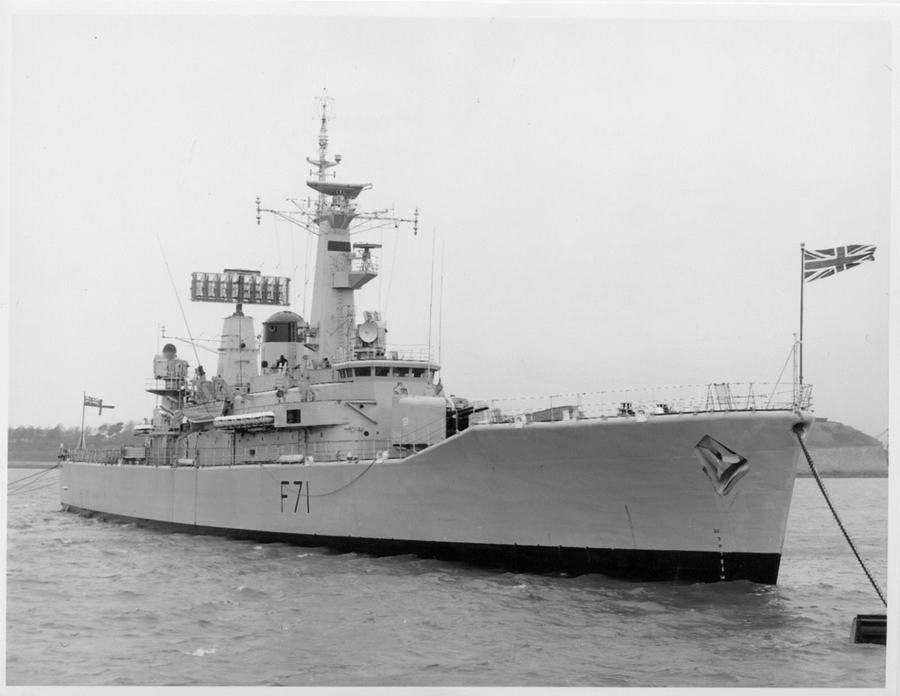
HMS Scylla (F71) on bouys
HMS Scylla (F71) was a Royal Navy Leander-class frigate, carrying pennant number F71. She belonged to the Type 12I family of Cold War escort ships and formed part of the generation of frigates that bridged the older gun-and-sonar age with the guided-missile and helicopter age. Broad-beam Leander later remembered as an artificial reef after disposal.
The Leander-class frigates were among the defining Royal Navy escort vessels of the Cold War. Developed as the Type 12I, or Improved Type 12, they grew from the Whitby and Rothesay anti-submarine frigate family but were conceived as more flexible ships. The Royal Navy had learned in the 1950s that highly specialised frigate designs could be expensive to build, difficult to support, and awkward to employ when the operational requirement changed.
The Leander answer was a comparatively compact, steam-turbine frigate that could still combine anti-submarine work, air-warning duties, gunfire, missile defence, helicopter operations, patrol, training, and overseas presence. The result was one of the most recognisable British warship silhouettes of the 1960s, 1970s, and 1980s.
The class was built in three broad groups between 1959 and 1973. Its 26 Royal Navy ships represented a major post-war construction programme spread across both royal dockyards and private yards. Their names were deliberately traditional, many drawn from former cruisers and from classical mythology, giving the class a lineage that connected modern Cold War frigates with older cruiser and fleet traditions. The Leanders became familiar in home waters, the North Atlantic, the Mediterranean, the Persian Gulf, the West Indies, and Far Eastern deployments. They were small enough to be numerous, large enough to carry meaningful sensors and weapons, and adaptable enough to receive expensive refits when the tactical problem changed.
In engineering terms, the Leanders were conventional but highly developed steam ships. They used oil-fired boilers, geared steam turbines, and twin shafts. Standard characteristics normally gave the class a length of about 113.4 metres, a beam of about 12.5 metres on the early ships and around 13.1 metres on the broad-beam ships, a full-load displacement generally approaching or exceeding 2,860 tons, and a speed of about 27 knots. The machinery demanded skilled marine engineering watchkeeping. Boiler-room and engine-room staffs had to manage steam raising, turbine operations, condensers, feed systems, pumps, gearing, shafting, and the constant maintenance burden of a warship expected to operate far from dockyard support.
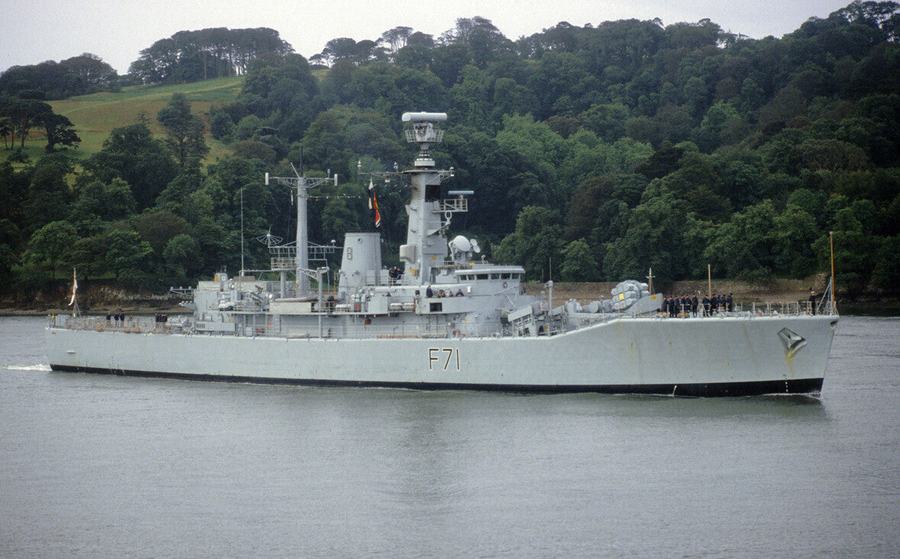
HMS Scylla (F71) passing Plymouth Sound
The first ships used Y-100 machinery, later ships Y-136 machinery, and the broad-beam group Y-160 machinery. The broad-beam design gave valuable extra volume and stability as weapons and electronics became heavier. The class retained the Royal Navy’s confidence in steam propulsion at a time when some other navies were turning increasingly to gas turbines or diesel machinery. Steam gave good sustained power and familiar maintenance routines, but it also required large engineering departments, careful boiler water treatment, and disciplined operational practice. The engineering spaces were as central to the effectiveness of a Leander as the operations room or bridge.
As completed, a Leander generally carried the twin 4.5-inch Mk 6 gun forward, Seacat surface-to-air missile equipment, the Limbo anti-submarine mortar aft, sonars, radars, and a helicopter facility for the Westland Wasp. The helicopter mattered because anti-submarine warfare had moved beyond the range of hull-mounted weapons alone.
A Wasp could carry a homing torpedo out to a sonar contact, extending the ship’s reach and turning the frigate into a small aviation platform. Later refits brought the Westland Lynx to several ships, giving better performance, sensors, and weapon-carrying capability.
The ships’ operational heart was the operations room. Radar plots, sonar contacts, electronic warfare indications, communications, navigation information, aircraft control, and weapon direction came together there. The Leander was not simply a gun-and-boiler ship. It was an integrated system, and each later modernisation made that system more complex. Communications ratings, radar operators, sonar teams, weapon engineers, electricians, marine engineers, aircraft handlers, seamen, cooks, writers, stewards, medical staff, and Royal Marines all formed part of the ship’s fighting and living community.
Mid-life modernisation reshaped the class. The Ikara conversions replaced the forward 4.5-inch gun with the Australian-designed Ikara anti-submarine missile, giving selected ships a stand-off ASW weapon. The Exocet/Seacat conversions exchanged the gun for MM38 Exocet anti-ship missiles and additional Seacat equipment, giving ships a surface strike role. The Exocet/Seawolf conversions were more ambitious, combining Exocet with the much more capable Sea Wolf point-defence missile system. The gun group retained the 4.5-inch gun and Seacat, preserving a more traditional general-purpose appearance.
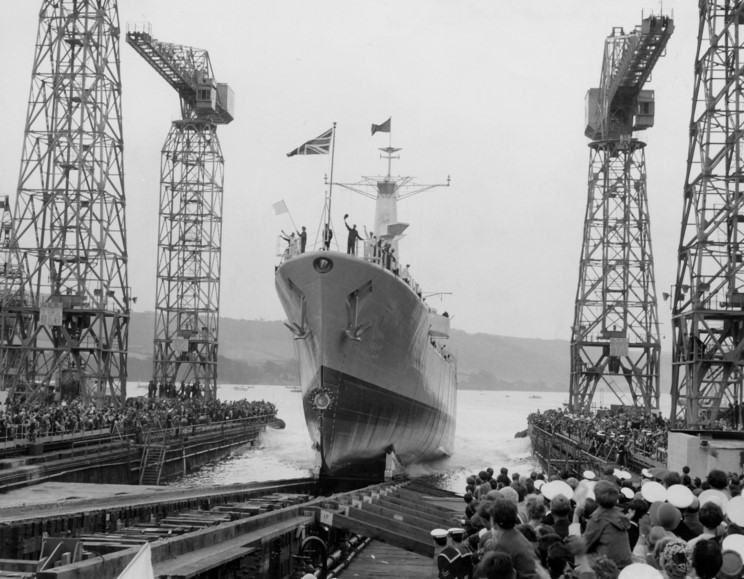
HMS Scylla (F71) launched 1968.
These refits demonstrate why the Leander class is historically important. They were not frozen in a single 1960s configuration. Instead they became test beds for changing Royal Navy doctrine. In the early Cold War the central fear was the Soviet submarine threat in the North Atlantic. Later, missile-armed surface combatants, air attack, and task-group defence became more pressing. The Falklands War also revealed the intense vulnerability of surface ships to aircraft and missiles, making the distinction between Seacat and Sea Wolf more than an equipment detail. A Leander’s conversion group therefore tells a story about the changing naval problem it was expected to solve.
Construction of each ship drew on a wide British shipbuilding network. Harland & Wolff, Yarrow, Cammell Laird, John Brown, Swan Hunter, Scotts, J. Samuel White, Devonport Dockyard, Portsmouth Dockyard, Alexander Stephen, Thornycroft, Hawthorn Leslie, Vickers, and others all appear in the class story.
The building programme is a snapshot of an industrial world that has largely disappeared. These ships were products not only of naval design but of regional yards, marine engineering firms, turbine makers, gearing specialists, foundries, electrical suppliers, and dockyard fitters. The Leander class therefore belongs as much to British industrial history as to fleet history.
Life aboard was crowded but more modern than in earlier frigates. The class introduced improved living conditions compared with older wartime designs, including air conditioning and better accommodation standards. Even so, a Leander was still a small ship by later standards. Noise, vibration, watchkeeping, machinery heat, rough weather, flying operations, maintenance routines, and long separations shaped daily life. The ships carried roughly 260 personnel, and every compartment had a purpose. The mess decks, galley, operations room, bridge, machinery spaces, magazines, and flight deck all reveal how tightly a Cold War frigate had to combine fighting capability with human endurance.
The Leanders served as fleet escorts, patrol ships, training ships, diplomatic visitors, and crisis-response vessels. They could join NATO exercises, watch Soviet units, patrol fisheries, support embargo operations, undertake West Indies guardship duties, or represent Britain in foreign ports. Their versatility made them useful even as new Type 21, Type 22, and Type 23 frigates gradually replaced them. Some ships later served with overseas navies, which extended the design’s life and influence. Their descendants and derivatives appeared in New Zealand, India, the Netherlands, Chile, Pakistan, Ecuador, and elsewhere.
A Leander page on this site should therefore be read in layers. At the top level it is a ship record: name, pennant, builder, dates, conversion group, armament, propulsion, and fate. At a deeper level it is a record of Cold War naval architecture: how the Royal Navy tried to balance anti-submarine warfare, missile defence, helicopters, surface strike, command systems, and habitability in a manageable hull. At another level it is a social and industrial record, preserving the memory of the crews who served, the shipyards that built, and the dockyards that refitted the class.
The class also provides a useful framework for database design. A site entry can treat the ship type as Frigate, the class as Leander-class frigate, and the individual vessel as a separate ShipPage with its own pennant number and date fields. The class page can then carry the broader engineering and design history, while each individual ship page can carry the ship-specific service career. This avoids repeating every technical explanation in every record but still lets readers understand how a single vessel fitted into the larger class story.
The Leander class was also an important training ground. Many officers and ratings who later served in newer frigates and destroyers gained experience in Leanders. The class taught seamanship, engineering watchkeeping, flight-deck operations, operations-room discipline, and the routines of NATO escort work. The ships were compact enough for crews to know them intimately but complex enough to expose personnel to the modern systems that would define late Cold War naval service. Their importance is therefore not measured only by weapon fit or deployments, but also by the generations of Royal Navy personnel formed aboard them.
Individual ship note
HMS Scylla should be understood as both an individual warship and as part of a much larger class story. Her construction at HM Dockyard, Devonport links her to the post-war British shipbuilding and marine engineering network. She was laid down on 17 May 1967, launched on 8 August 1968, and commissioned on 12 February 1970. These dates place her within the wider Leander programme, in which ships were built, accepted, refitted, and adapted over more than a decade.
Her pennant number, F71, is useful for distinguishing her from earlier Royal Navy ships of the same name. Many Leander names had already appeared on cruisers or earlier warships, and several names had long classical or mythological associations. The reuse of such names gave the modern frigates a historic identity while placing them firmly within the technical world of Cold War anti-submarine warfare.
Operational setting
HMS Scylla (F71) belonged to a generation of Royal Navy frigates designed for persistent escort work rather than short-lived fleet display. Her value lay in availability, endurance, and adaptability. A Leander could escort a carrier or amphibious group, join NATO anti-submarine exercises, make an overseas deployment, undertake patrol work, or represent the Royal Navy during visits to allied and Commonwealth ports. The ship's relatively compact size concealed a complex mix of engineering, aviation support, weapons, communications, sensors, and accommodation. That balance explains why the class remained useful for so long and why individual ships often had careers that changed shape as Cold War priorities changed.
The engineering story is central to understanding HMS Scylla. Steam turbine machinery demanded a disciplined engineering department, careful boiler-water management, regular maintenance, and constant watchkeeping. The ship's operational readiness depended not only on bridge handling and gunnery but also on stokers, artificers, electrical specialists, weapon engineers, and communications ratings working below decks and behind the scenes. In a frigate of this size, machinery performance, fuel endurance, stores management, and crew routine all affected what the ship could do on station.
HMS Scylla (F71) was also part of the transition from gun-era escorts to missile-equipped surface combatants. Early Leanders retained the visual character of a traditional post-war frigate, with a forward gun and an anti-submarine emphasis. Later conversions altered that identity. Missile systems, improved sensors, helicopter operation, and changing command arrangements made the class a bridge between Second World War escort experience and the more automated, missile-centred warships that followed. This makes each ship valuable not simply as a named vessel but as evidence of how the Royal Navy adapted to new threats.
For researchers, the key dates and details help distinguish HMS Scylla (F71) from earlier ships of the same name. She was associated with the pennant number F71, was launched 8 August 1968, and was commissioned 12 February 1970. Her builder is recorded as HM Dockyard, Devonport. Her later fate is recorded as To be expanded from ship-specific references. These facts provide the framework for a more detailed account of deployments, refits, exercises, and crew experience.
The Leander class remains significant because it was familiar, numerous, and adaptable. These ships carried Cold War naval policy into daily practice. They were seen in home waters, the Mediterranean, the South Atlantic, the Gulf, the Caribbean, the Far East, and on NATO exercises. Their histories connect shipbuilding towns, naval bases, foreign transfers, weapons development, and the memories of crews who served in a rapidly changing navy. HMS Scylla (F71) should therefore be read as both an individual frigate and as part of the broader Leander story.
Ships in this Class
HMS Achilles (F12) – Frigate – Leander-class frigate (F12)
HMS Ajax (F114) – Frigate – Leander-class frigate (F114)
HMS Andromeda (F57) – Frigate – Leander-class frigate (F57)
HMS Apollo (F70) – Frigate – Leander-class frigate (F70)
HMS Arethusa (F38) – Frigate – Leander-class frigate (F38)
HMS Argonaut (F56) – Frigate – Leander-class frigate (F56)
HMS Ariadne (F72) – Frigate – Leander-class frigate (F72)
HMS Aurora (F10) – Frigate – Leander-class frigate (F10)
HMS Bacchante (F69) – Frigate – Leander-class frigate (F69)
HMS Charybdis (F75) – Frigate – Leander-class frigate (F75)
HMS Cleopatra (F28) – Frigate – Leander-class frigate (F28)
HMS Danae (F47) – Frigate – Leander-class frigate (F47)
HMS Dido (F104) – Frigate – Leander-class frigate (F104)
HMS Diomede (F16) – Frigate – Leander-class frigate (F16)
HMS Euryalus (F15) – Frigate – Leander-class frigate (F15)
HMS Galatea (F18) – Frigate – Leander-class frigate (F18)
HMS Hermione (F58) – Frigate – Leander-class frigate (F58)
HMS Juno (F52) – Frigate – Leander-class frigate (F52)
HMS Jupiter (F60) – Frigate – Leander-class frigate (F60)
HMS Leander (F109) – Frigate – Leander-class frigate (F109)
HMS Minerva (F45) – Frigate – Leander-class frigate (F45)
HMS Naiad (F39) – Frigate – Leander-class frigate (F39)
HMS Penelope (F127) – Frigate – Leander-class frigate (F127)
HMS Phoebe (F42) – Frigate – Leander-class frigate (F42)
HMS Scylla (F71) – Frigate – Leander-class frigate (F71)
HMS Sirius (F40) – Frigate – Leander-class frigate (F40)