HMS Hood (51)
HMS Hood: builder, dates, armament, propulsion, service career and fate.
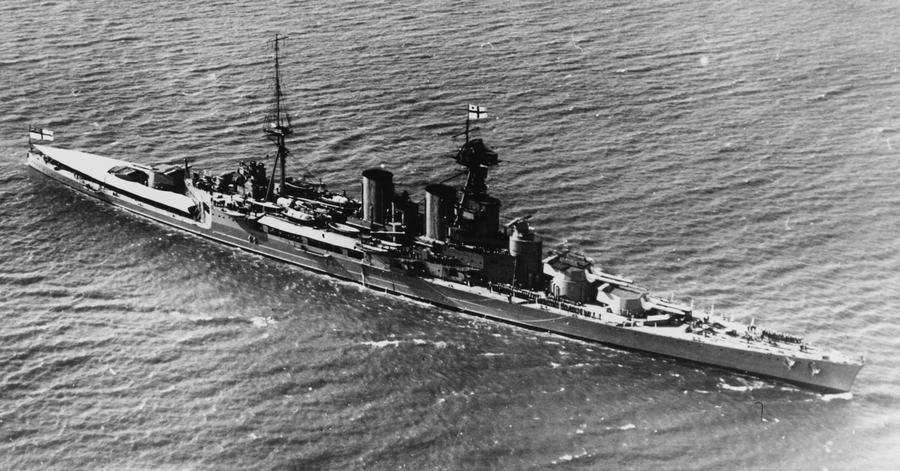
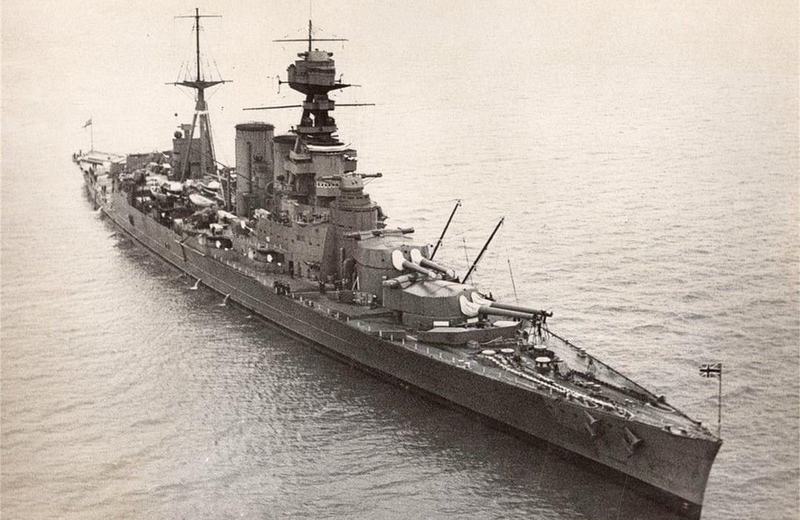
HMS Hood in American waters, circa June-July 1924. Note Vice-Admiral's flag flying from her foremast.
HMS Hood was one of the most famous warships ever to serve in the Royal Navy. To the British public between the wars she was not merely a battlecruiser; she was “the Mighty Hood,” a floating symbol of imperial sea power, technological ambition, and national prestige. Her long, graceful hull, heavy guns, high speed and worldwide cruises made her perhaps the best-known fighting ship in the world before the Second World War. Yet her fame is inseparable from tragedy. On the morning of 24 May 1941, in the Denmark Strait between Greenland and Iceland, Hood was destroyed during battle with the German battleship Bismarck. Out of a crew of 1,418, only three men survived, making her loss one of the most devastating disasters in Royal Navy history.
Hood belonged to the Admiral class, a projected group of British battlecruisers developed during the First World War. She was the only one completed. The battlecruiser concept had grown from the belief that a ship could combine battleship-sized guns with cruiser speed, sacrificing some protection in exchange for the ability to scout, pursue, outflank, and destroy weaker enemies. The idea had great appeal in the early twentieth century, when speed and heavy gunnery seemed to promise tactical freedom. But the Battle of Jutland in 1916 exposed the danger of insufficient protection in capital ships. British battlecruisers suffered catastrophic magazine explosions, and the lessons of Jutland influenced Hood’s design while she was still under construction. Her protection was revised, and she emerged as a more heavily protected vessel than earlier British battlecruisers, though not as comprehensively armoured as a true battleship.
Hood was laid down at John Brown & Company’s shipyard at Clydebank, one of the great centres of British heavy shipbuilding. Her construction linked the Royal Navy to the industrial strength of the Clyde: steelworkers, riveters, draughtsmen, engineers, armour-plate specialists, turbine builders, electricians and shipwrights all contributed to the making of the ship. She was launched on 22 August 1918, only months before the armistice ended the First World War, and was commissioned in 1920. By then the strategic world that had produced her had changed. Germany’s High Seas Fleet had been interned and scuttled, wartime urgency had faded, and Britain faced the financial pressures of peace. The remaining Admiral-class ships were cancelled, leaving Hood as a unique survivor of a wartime design adapted for a post-war navy.
Her appearance was part of her legend. Hood was long, fast and elegant, with a distinctive silhouette and a sense of visual balance that made her seem almost purpose-built for public imagination. She displaced more than many battleships and carried eight 15-inch guns in four twin turrets. These guns gave her a formidable broadside. Her machinery was designed to produce high speed, allowing her to operate with the fleet, respond to crises, and show the flag across great distances. In an era when navies were instruments of diplomacy as much as combat, Hood’s size and speed made her a mobile declaration of British maritime power.
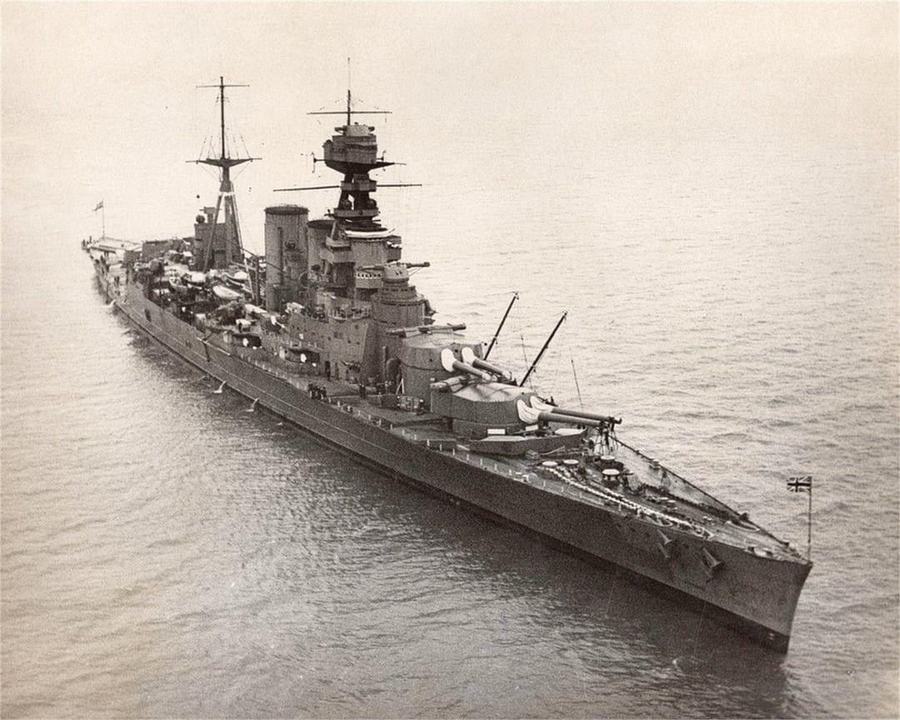
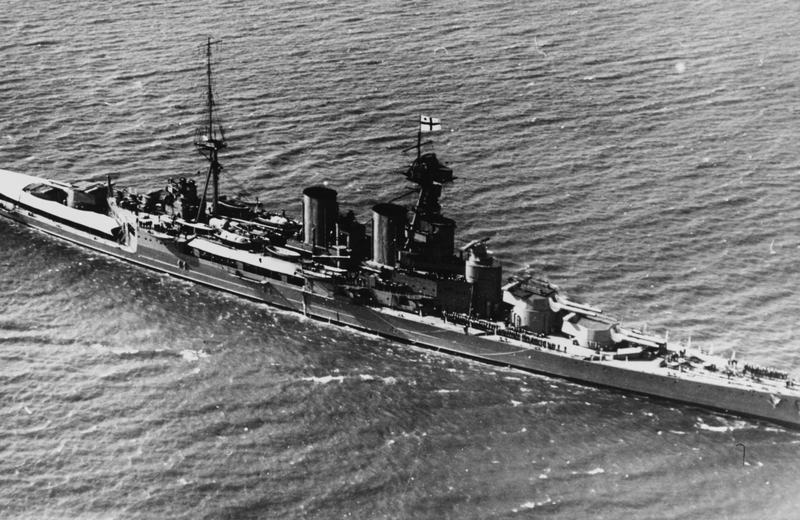
HMS Hood (51) at sea during the inter-war years, 1935.
During the 1920s and 1930s, Hood became the Royal Navy’s great ambassador. She visited ports across the world, serving as a visible expression of British influence at a time when the empire still depended on sea communications. Her most famous peacetime deployment was the Special Service Squadron’s world cruise of 1923–1924, during which Hood and other Royal Navy ships visited imperial and foreign ports. Such voyages were not ceremonial luxuries. They reassured allies, impressed rivals, connected dominions to the imperial centre, and gave sailors experience of global operations. For many civilians who saw her in harbour, Hood represented the Royal Navy itself.
Life aboard Hood reflected both grandeur and hardship. A capital ship was a floating town, with a crew usually numbering well over a thousand men. There were officers, seamen, stokers, marines, signalmen, gunners, torpedomen, electricians, cooks, writers, sick-berth attendants and engineers. The ship required constant cleaning, painting, maintenance, drill and watchkeeping. Her guns, magazines, engines, boilers, wireless rooms, plotting spaces and turrets all demanded specialist labour. The public saw ceremonial visits and imposing photographs; the crew knew cramped mess decks, noisy machinery, strict routine, coal-smoke memory giving way to oil-fired power, and the unending discipline of a warship that had to remain ready even in peace.
Hood’s prestige also masked a growing problem. She aged during a period of rapid naval change. Aircraft became more dangerous. Fire-control systems improved. Armour protection standards changed. Anti-aircraft warfare became more important. Torpedo threats increased. By the late 1930s, Hood needed a major reconstruction. Plans existed for a large repair and modernisation, but the pressures of rearmament, limited dockyard capacity and the demands of keeping major warships available delayed the work. The HMS Hood Association notes that a proposed large repair was not scheduled to begin until at least spring 1942, by which time Hood had already been lost.
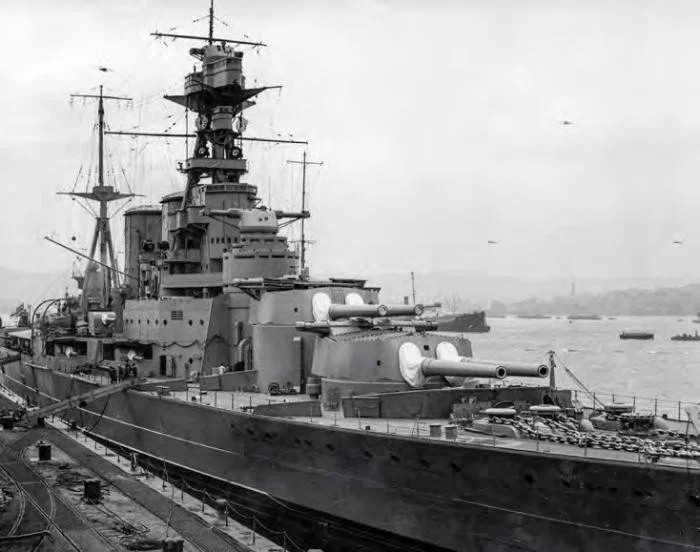
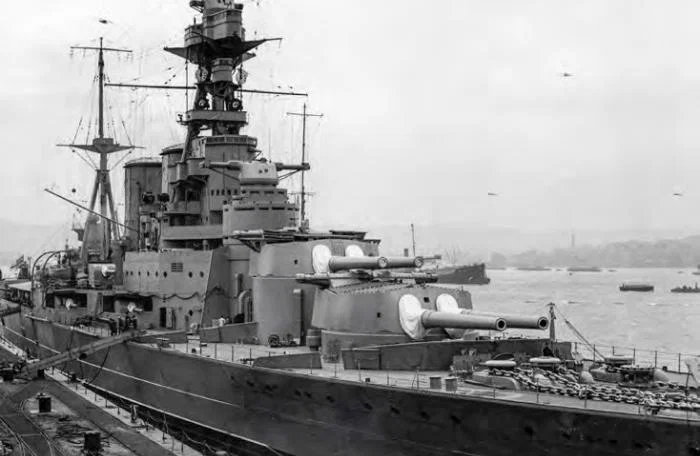
HMS Hood alongside
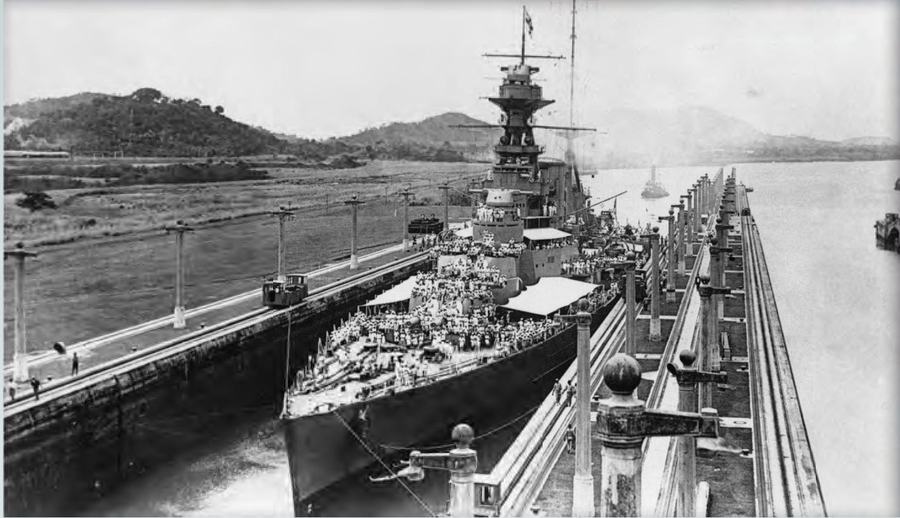
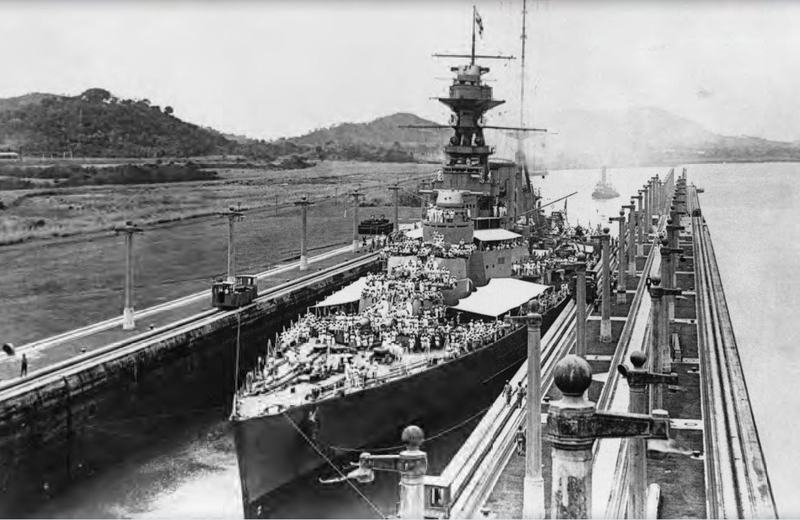
HMS Hood in the Panama Canal locks
This delayed reconstruction is central to Hood’s history. She was not an obsolete ship in the simple sense. She was still fast, heavily armed and operationally valuable. But she was a First World War-era capital ship trying to serve in a Second World War environment. Her deck protection, anti-aircraft defences, internal subdivision and modern command systems were not what they would have been had she received the full reconstruction planned for her. The Royal Navy knew that older capital ships needed modernisation, but it also needed hulls at sea. Hood’s fate cannot be reduced to one design flaw, but her career shows the danger of relying on prestige ships whose symbolic value had outlasted their modernisation schedule.
When the Second World War began in September 1939, Hood was still one of the Royal Navy’s most important capital ships. She served with the Home Fleet and took part in patrols and operations intended to contain German naval movement. The early war at sea placed enormous pressure on Britain. The country depended on Atlantic shipping for food, fuel, troops and war material. German surface raiders and heavy ships threatened those routes, not necessarily by sinking warships but by forcing convoys to scatter, delaying trade, and tying down British naval resources. Hood’s speed and heavy guns made her a natural choice for hunting enemy raiders.
In 1940 Hood took part in one of the most controversial actions of the war: the attack on the French fleet at Mers-el-Kébir. After France’s defeat, Britain feared that French warships might fall under Axis control. British forces were ordered to neutralise the French squadron in Algeria if agreement could not be reached. Hood was part of Force H during the operation. The episode was tragic and politically painful, involving British fire against former allies, but it reflected the desperate strategic calculations of 1940, when Britain stood isolated and could not risk powerful ships being added to the Axis naval threat.
By 1941, the German Navy sought to break major surface units into the Atlantic to attack Allied shipping. The battleship Bismarck and the heavy cruiser Prinz Eugen sailed in Operation Rheinübung, attempting to pass from the Baltic and Norwegian waters into the Atlantic. Bismarck was new, powerful and heavily armoured, armed with eight 15-inch guns. If she reached the convoy routes, she could cause serious disruption. British cruisers HMS Suffolk and HMS Norfolk shadowed the German force as it moved through the Denmark Strait. The Admiralty reacted by sending heavy units to intercept, including HMS Hood and the newly commissioned battleship HMS Prince of Wales.
The British force was commanded by Vice-Admiral Lancelot Holland in Hood. Captain Ralph Kerr commanded the ship herself. Prince of Wales, under Captain John Leach, was a modern battleship but still working up; her main armament suffered from mechanical problems during the action. Holland faced difficult tactical choices. He wanted to close the range quickly, reducing the danger of plunging fire that could strike Hood’s decks, but this approach initially limited the number of British guns able to bear. The battle began early on 24 May 1941 in poor visibility and cold northern waters.
Hood opened fire, initially targeting Prinz Eugen, which was mistaken for Bismarck because of the German ships’ formation and similarity of silhouette at range. Prince of Wales engaged as well. The German ships returned fire. Within minutes, Hood was hit. One fire was seen on or near her boat deck, probably involving ready-use ammunition. Then, at about 6 a.m., a catastrophic explosion tore the ship apart. The generally accepted explanation is that a shell from Bismarck penetrated or otherwise caused the detonation of Hood’s magazines, producing the immense explosion that destroyed her. The Admiralty later concluded that magazine penetration by a 38 cm shell from Bismarck was the most likely explanation.
The destruction was almost instantaneous. Witnesses saw a huge column of flame and smoke. Hood broke apart and sank within minutes. Her bow rose, her stern disappeared, and wreckage spread across the sea. Of the 1,418 men aboard, only three survived: Ted Briggs, Bob Tilburn and Bill Dundas. They were rescued by the destroyer HMS Electra after spending around two hours in the freezing water. The scale of loss shocked Britain. Hood had been more than a ship in public consciousness; she had been an emblem of national strength. Her sudden destruction by Bismarck was therefore a military disaster, a human catastrophe and a psychological blow.
Prince of Wales continued the engagement briefly despite damage and gunnery defects, then disengaged under smoke. The German force had won the immediate action, but the victory was short-lived. Bismarck had been damaged, including hits that affected fuel and seaworthiness. The loss of Hood provoked a massive British pursuit. Royal Navy forces across the Atlantic were directed toward the hunt. Aircraft from HMS Ark Royal later crippled Bismarck’s steering with a torpedo hit, and British battleships and cruisers closed in. On 27 May 1941, Bismarck was sunk. The pursuit became one of the most famous naval episodes of the Second World War.
Hood’s loss generated immediate questions. How had such a great ship been destroyed so quickly? Was her armour inadequate? Had unsafe ammunition handling contributed? Had design compromises dating from the battlecruiser era doomed her? Admiralty inquiries examined the evidence, but the speed of the sinking and the loss of almost all witnesses made certainty impossible. Later study of the wreck has added evidence, but debate has continued over the precise sequence of events. What is clear is that Hood suffered a magazine explosion after being hit during action with Bismarck. Whether the fatal path involved deck penetration, belt penetration, fire spread, or a complex interaction of blast and internal vulnerability, the result was the same: a capital ship was destroyed in minutes.
The tragedy of Hood is often discussed through armour and gunnery, but the human loss must remain central. More than 1,400 men died with the ship. Many were young. Some had served in Hood for years; others were wartime additions. They came from across Britain and the wider naval community. Their deaths left families without sons, husbands, fathers and brothers. The ship’s fame meant that the disaster was widely mourned, but fame could not make the grief less private. Every name on the casualty list represented a life shaped by naval service and ended in the cold waters of the Denmark Strait.
The memory of Hood endured partly because of the three survivors. Ted Briggs in particular became closely associated with preserving the ship’s story. Survivors’ testimony gave later generations some sense of the final moments: the shock, the speed, the plunge into the sea, and the disbelief that such a large ship had vanished so quickly. Their memories helped transform Hood from a symbol of naval architecture into a human story of survival, loss and remembrance.
Hood’s wreck was found in 2001 by an expedition led by David Mearns. The discovery confirmed the wide dispersal of the wreckage and gave historians and naval analysts more physical evidence. In 2015, Hood’s bell was recovered from the wreck site with the support of philanthropist Paul Allen and later placed in the National Museum of the Royal Navy. The Royal Navy reported that the bell was rededicated in Portsmouth on the seventy-fifth anniversary of the ship’s loss, becoming a memorial to those who died.
The bell carries unusual emotional weight. A ship’s bell is not just a fitting. It marks time, ceremony, identity and continuity. For Hood, whose hull remains a war grave, the bell is a tangible survivor from a ship that otherwise lives through photographs, documents, wreck imagery and memory. Its recovery gave families and historians a physical focus for remembrance without disturbing the essential sanctity of the wreck. The Denmark Strait remains the resting place of Hood’s dead.
Historically, Hood occupies a complex place. She was a triumph of British shipbuilding and a warning about technological transition. She embodied the battlecruiser ideal at its most impressive, but she also demonstrated the limitations of that ideal when capital ships faced modern long-range gunnery, aircraft-era threats and delayed reconstruction. She was powerful but vulnerable, famous but overworked, admired but insufficiently modernised. Her loss did not prove that the Royal Navy was weak; the subsequent destruction of Bismarck showed the reach and determination of British sea power. But Hood’s destruction did prove that symbolic ships could die as quickly as any other when steel, shellfire and chance met in battle.
Her story also belongs to the wider history of British society. Hood was built by industrial labour on the Clyde, maintained by dockyard skill, crewed by men from many regions and backgrounds, and mourned by a public that had followed her peacetime career for two decades. She connected shipyard communities, naval families, imperial port cities and wartime households. In the interwar years she projected confidence; in 1941 her loss revealed the cost of war in its most brutal form.
In naval design history, Hood stands between eras. She came from the world of dreadnoughts and battlecruisers, where speed and heavy guns defined capital-ship prestige. She died in a war increasingly shaped by radar, aircraft, submarines, signals intelligence and combined operations. She was destroyed by gunfire, but the campaign around her death involved reconnaissance, shadowing cruisers, carrier aircraft, fuel damage, radio signals and fleet coordination. The age of the big-gun ship had not ended, but it was no longer supreme in the simple way imagined before 1914.
HMS Hood remains unforgettable because her career contains both splendour and catastrophe. She was admired in life as the most beautiful and famous warship of the Royal Navy. She was lost in battle with shocking suddenness. Her destruction set in motion one of the great naval pursuits of the Second World War. Her dead became part of the Royal Navy’s roll of sacrifice. Her bell, recovered decades later, gave material form to remembrance. Her wreck remains beneath the Denmark Strait, a grave and a warning.
To recount Hood’s history is therefore to recount more than the life of one ship. It is to follow the Royal Navy from the First World War into the uncertain peace, from imperial display into global crisis, from confidence in battlecruiser speed to the harsh lessons of modern naval combat. Hood was steel, guns, turbines and armour, but she was also reputation, labour, discipline, pride and loss. She served as ambassador, deterrent, fighting ship and finally memorial. Her name still carries a force that few warships possess, because she represents both the height of British naval prestige and the terrible speed with which war can destroy it.