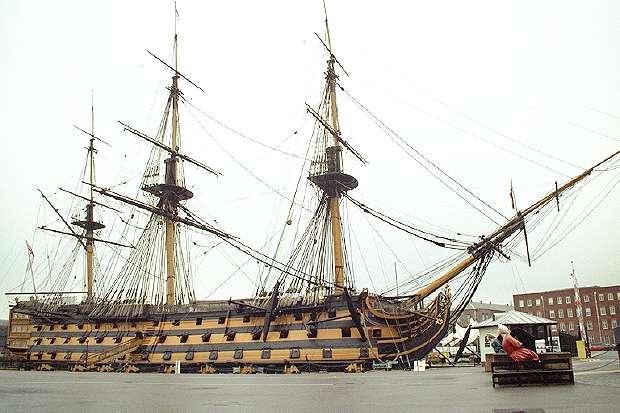
HMS Victory at Portsmouth, United Kingdom
HMS Victory is one of the most famous warships in British naval history. Best known as Vice-Admiral Horatio Nelson’s flagship at the Battle of Trafalgar in 1805, she also had a long fighting career before Trafalgar and survives today as a museum ship at Portsmouth Historic Dockyard. She is both a symbol of Royal Navy power in the age of sail and a rare physical survivor of eighteenth-century shipbuilding.
HMS Victory at Portsmouth, United Kingdom
HMS Victory was ordered in 1758 during the Seven Years’ War and built at Chatham Dockyard, one of the Royal Navy’s great royal dockyards. Her keel was laid in 1759, and she was launched on 7 May 1765. Designed by Sir Thomas Slade, Surveyor of the Navy, she was a first-rate ship of the line: a three-decked warship built to stand in the line of battle and carry more than 100 guns. Her construction required thousands of mature oak trees, skilled shipwrights, and years of dockyard labour. Although launched in 1765, she was not immediately sent to war; like many large warships, she spent time laid up before being commissioned for active service in 1778.
Victory first saw major service during the American War of Independence. She fought at the First Battle of Ushant in 1778 and was later involved in further operations connected with the war at sea against France and Spain. Her career continued through the late eighteenth century, including service during the Great Siege of Gibraltar, the Battle of Cape Spartel in 1782, the Battle of the Hyères Islands in 1795, and the Battle of Cape St Vincent in 1797. By the time she became Nelson’s flagship, she was already an old but respected ship with decades of naval service behind her.
HMS Victory (1765): Nelson’s Flagship and the Living Warship of the Royal Navy
No articles are available yet.