HMS Victory (1765)
Learn about HMS Victory (1765), a Trafalgar participant.
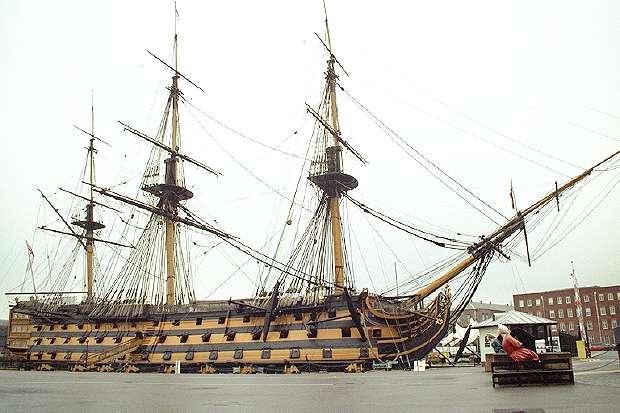
HMS Victory at Portsmouth, England.
HMS Victory: Nelson’s Flagship and the Living Warship of the Royal Navy
Construction
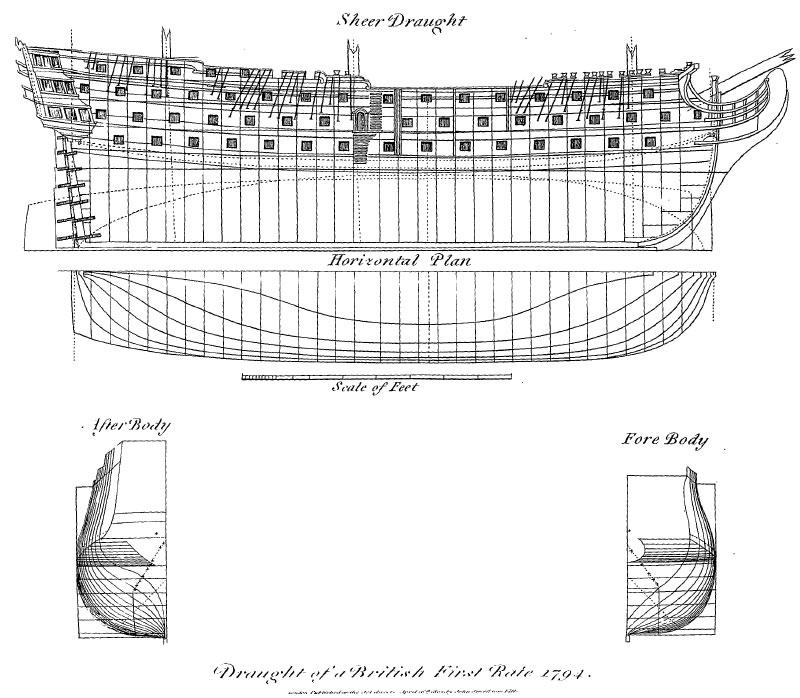
HMS Victory was ordered in 1758, during the Seven Years’ War, at a time when Britain required powerful ships of the line to challenge France and Spain at sea. She was designed by Sir Thomas Slade, Surveyor of the Navy, and built at Chatham Dockyard, one of the great royal dockyards of the eighteenth-century Royal Navy.
Her keel was laid on 23 July 1759, the same year as Britain’s “Year of Victories”, when British arms achieved major successes around the world. Victory was built as a first-rate ship of the line, meaning she was one of the largest and most heavily armed warships in the fleet. She had three gun decks and was designed to carry more than 100 guns.
The construction of a ship like Victory was a vast undertaking. Thousands of mature oak trees were required for her frame and planking. Skilled shipwrights, caulkers, sawyers, blacksmiths, ropemakers, and dockyard labourers all contributed to her building. Her hull was designed for strength, endurance, and the ability to survive the punishment of close-range fleet battle. She was launched on 7 May 1765, but like many large warships of the period, she did not immediately go to sea. Instead, she spent years laid up in ordinary before being commissioned for active service.
Commission
HMS Victory was first commissioned in 1778, during the American War of Independence, when Britain was at war with France and later Spain and the Dutch Republic. Her first major commander was Captain John Lindsay, and she soon became a flagship, the role for which she would become most famous.
A first-rate such as Victory was not just a fighting ship. She was also a command platform. Admirals required large ships with space for staff, signals, charts, correspondence, and meetings with captains. Victory’s size, firepower, and prestige made her suitable for this role. Over her career she served as flagship to several important commanders before Nelson ever stepped aboard her.
Her commissioning brought together a large crew of sailors, Royal Marines, officers, warrant officers, boys, craftsmen, and servants. At full strength, she could carry around 800 to 850 men. Life aboard was crowded, disciplined, and dangerous. The ship required constant labour: sails had to be handled, guns maintained, ropes repaired, decks cleaned, food prepared, and the hull kept seaworthy.
Service
Before Trafalgar, HMS Victory had already enjoyed a long and important career. She served in the American War of Independence, the French Revolutionary Wars, and the Napoleonic Wars. Her duties included fleet actions, blockades, patrols, and command service.
In the late eighteenth century, the Royal Navy’s role was global. It protected trade, challenged enemy fleets, transported troops, and maintained pressure on hostile ports. Large ships of the line like Victory were the backbone of British naval strategy. Their greatest purpose was to fight in line of battle, where opposing fleets formed long lines and exchanged broadsides.
Victory also spent periods undergoing repair and refit. Wooden warships required constant maintenance. Salt water, rot, battle damage, storms, and strain from their own heavy guns all took a toll. By the time of Trafalgar, Victory was already 40 years old, yet she had been rebuilt and repaired enough to remain a formidable fighting ship.
Battles
HMS Victory took part in several major actions before and during the Napoleonic Wars.
Her first great battle was the First Battle of Ushant in 1778, fought between the British and French fleets during the American War of Independence. Although the result was disputed, the battle marked Victory’s entry into major fleet warfare.
She later served during operations connected with the Great Siege of Gibraltar, one of the key strategic struggles of the war. In 1782, she was present at the Battle of Cape Spartel, fought between British and Franco-Spanish forces after the relief of Gibraltar.
During the French Revolutionary Wars, Victory was again heavily involved in fleet service.
In 1795, she took part in the Battle of the Hyères Islands, an action against the French Mediterranean fleet. In 1797, she served as flagship to Admiral Sir John Jervis at the Battle of Cape St Vincent, a major British victory over the Spanish fleet. This battle was also important in the rise of Horatio Nelson, who distinguished himself by bold action aboard HMS Captain.
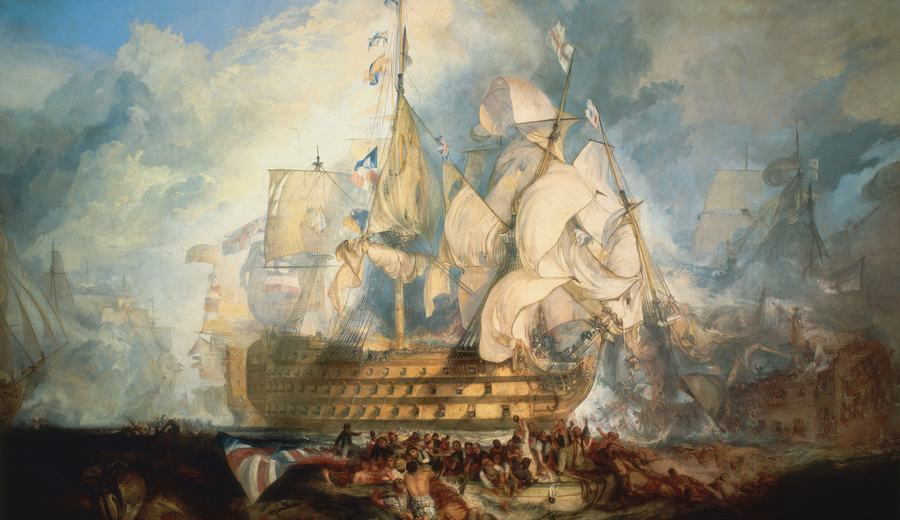
The most famous battle in Victory’s career was the Battle of Trafalgar on 21 October 1805. At Trafalgar, she served as Nelson’s flagship. Nelson commanded the British fleet against the combined French and Spanish fleet under Admiral Villeneuve. Rather than forming a traditional parallel line of battle, Nelson divided his fleet into columns and drove directly at the enemy line.
Victory led the weather column. As she approached the enemy, she endured heavy fire before being able to reply effectively. She broke through the enemy line near the French flagship Bucentaure and then became locked in close combat with the French ship Redoutable. The fighting was brutal and close-range. Musket fire, cannon shot, splinters, smoke, and falling rigging filled the decks.
It was during this battle that Nelson was mortally wounded by a shot fired from the fighting tops of Redoutable. He was carried below to the cockpit, where he died after learning that victory had been secured. Trafalgar destroyed the immediate threat of invasion and confirmed British naval dominance, but it also made Victory forever associated with Nelson’s death and Britain’s greatest naval victory.
Famous People Who Served Onboard
The most famous person associated with HMS Victory is Vice-Admiral Horatio Nelson. He used her as his flagship during the Trafalgar campaign, and his death aboard her transformed the ship into a national symbol.
Another famous figure was Captain Thomas Masterman Hardy, Victory’s captain at Trafalgar. Hardy was responsible for the ship’s handling in battle and was beside Nelson during parts of the action. He is remembered for his loyalty to Nelson and for his role in the final moments of the admiral’s life.
Admiral Sir John Jervis, later Earl St Vincent, also used Victory as his flagship. Under Jervis, she played a central role at the Battle of Cape St Vincent in 1797. Jervis was one of the great disciplinarians and organisers of the Royal Navy.
Admiral Augustus Keppel was another senior officer connected with Victory, commanding from her during the American War of Independence. Keppel’s career reflected the political and naval tensions of the late eighteenth century.
The ship’s story also belongs to the hundreds of less famous men who served aboard her: ordinary seamen, marines, gunners, carpenters, surgeons, cooks, powder boys, and officers whose names are less widely remembered. At Trafalgar, these men fought the ship, repaired damage, carried powder, served the guns, tended the wounded, and kept the vessel alive under fire.
Later Service and Museum Warship
After Trafalgar, HMS Victory did not immediately become a museum piece. She continued in service, though not again as a front-line battlefleet flagship in the same way. Over time, as naval technology changed, wooden sailing ships were overtaken by steam power, iron construction, armour, and modern artillery.
Victory was eventually used for harbour service. She became a depot, accommodation, and ceremonial vessel. By the nineteenth and early twentieth centuries, her historic importance was increasingly recognised, but her physical condition was deteriorating.
In 1922, she was moved into dry dock at Portsmouth, where she was preserved as a historic warship. This marked the beginning of her modern life as a museum ship. Visitors could walk her decks, see the gun decks, view the place associated with Nelson’s death, and understand the environment of an eighteenth-century warship.
Today, HMS Victory is part of the National Museum of the Royal Navyat Portsmouth Historic Dockyard. She is one of the oldest commissioned warships in the world and remains one of Britain’s most important naval heritage sites.
Her Present Duties
HMS Victory is not only a preserved ship. She remains a commissioned warship of the Royal Navy and serves as the flagship of the First Sea Lord, the professional head of the Royal Navy. This gives her a continuing ceremonial and symbolic role within the modern service.
Her present duties are therefore both historical and naval. She represents the continuity of the Royal Navy from the age of sail to the present day. She is used for heritage, education, remembrance, ceremonial occasions, and public engagement. She also stands as a memorial to Nelson and to all those who served and died in the sailing navy.
In recent years, Victory has been undergoing a major conservation project. Her timbers, structure, paintwork, rigging, and supports require careful attention. Preserving a wooden warship of her age is complex and expensive. The current conservation work aims to protect her for future generations while allowing visitors to continue learning from her.
HMS Victory is therefore more than Nelson’s flagship. She is a survivor of eighteenth-century dockyard craft, a veteran of major fleet battles, a memorial to those who fought at Trafalgar, a museum ship, and a living symbol of the Royal Navy’s long history.
Further reading:
A Short History of HMS Victory by Captain W.J.L. Wharton, RN, Griffin & Co,2, The Hard, Portsmouth.