A Short History of HMS Victory - Part Eight
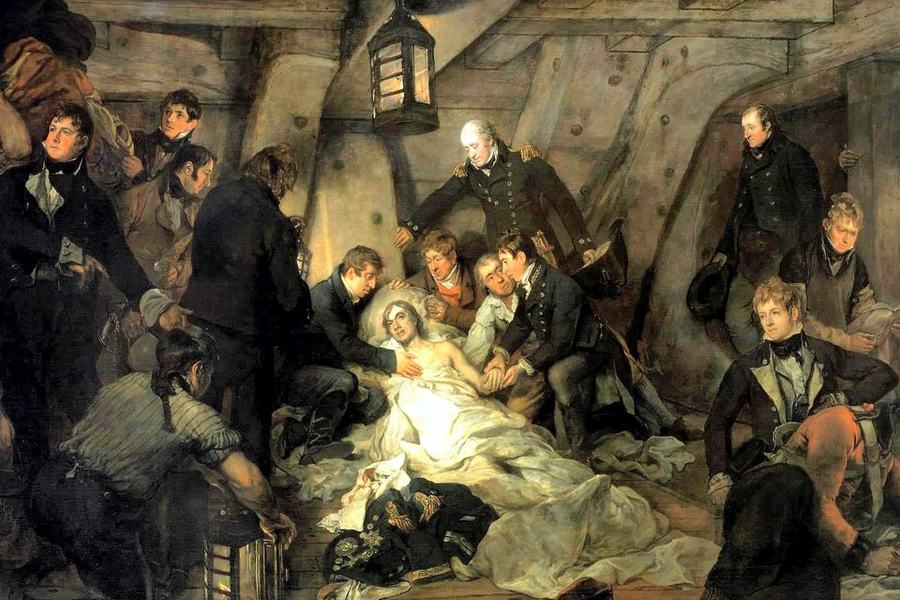
The Death of Nelson (Arthur William Devis, 1807. National Maritime Museum
Death of Nelson
By 4.30 p.m. the action was over, and a victory was reported to Lord Nelson just before his death. We left him in the cockpit, where he was attended by Dr. Scott, the chaplain, and Mr Burke, the purser. He had sent the doctor away to attend to the other wounded, and lay in great agony, fanned with paper by those two officers, and giving his last directions as to those he loved; but ever and anon interrupted by the cheers of the Victory’s crew, he would ask the cause, and being told it was a fresh enemy’s ship that had struck her flag, his eye would flash as he expressed his satisfaction. He frequently asked for Captain Hardy, and that officer not being able to leave the deck, his anxiety for his safety became excessive, and he repeated, “he must be killed;” “he is surely destroyed.” An hour had elapsed before Hardy was able to come to him, when they shook hands, and the Admiral asked — “How goes the day with us.” “Very well, my Lord,” was the reply; “we have about 12 of the enemy in our possession.”
After a few minutes of conversation, Hardy had again to return on deck, and shortly after the Victory’s port guns redoubled their fire on some fresh ships coming down on her, and the concussion so affected Lord Nelson that he cried in agony, “Oh! Victory!’ ‘Victory!’ how you distract my poor brain;” but, weak and in pain as he was, he indignantly rebuked a man, who in passing through the crowded cockpit struck against and hurt one of the wounded.
Captain Hardy again visited him in about another hour, and, holding his Lordship’s hand, congratulated him on a brilliant victory, saying, he was certain that 14 ships had surrendered. “That is well,” he answered,” but I bargained for 20.” Then, Hardy having again to go on deck, Nelson after emphatically telling him to anchor, and declaring his intention to direct the fleet as long as life remained, said, “kiss me Hardy,” the Captain knelt down and kissed him, when he said, “Now I am satisfied. Thank God I have done my duty.” Twenty minutes later he quietly passed away, having again and again repeated to his last breath, the words above mentioned. They were, it has been well remarked, the whole history of his life.
On the firing ceasing, the Victory had lost 57 killed and 103 wounded, and found herself all but a wreck. The tremendous fire to which she was exposed, when leading her line into action, had caused great damage, at a very early period of the battle, and before she herself fired a gun, many of her spars were shot away, and great injury was done to the hull, especially the fore part of it.
At the conclusion of the action, she had lost her mizen mast, the fore-topmast had to be struck to save the foremast; the mainmast was not much better, and it took all the exertions of her crew to refit the rigging sufficiently to stand the bad weather that followed.
The actual number of prizes taken by 5 p.m., on October 21st, were 19; so that Nelson’s desired number was nearly made up; but from their disabled condition, they were nearly all wrested from us by the gales that succeeded the battle. Lord Nelson had doubtless foreseen this, and thence his wish to anchor, and as a matter of fact, most of those few ships and prizes that did anchor, rode the gale out in safety and were saved; but the majority of the vessels were either anchorless, or in such deep water that they could not with convenience anchor.
The Victory’s trophy, the Redoutable, was one of those that sunk after the action in deep water, and in her, as in many of the other vessels lost, went down her prize crew of British seamen. The English fleet were in nearly as disabled a state as their prizes, as might be expected after such a battle, and it is a matter of wonder that some of them were not lost on the treacherous shoal that swallowed up so many of the captured ships.
The enemy’s fleet of 33 sail was disposed of as follows:
Taken into Gibraltar … … 4
Burnt by the English … … 3
Sunk by the English … … 3
Wrecked during the gale … … 9
19 lost to the enemy.
Struck, but afterwards got into Cadiz crippled … 2
Escaped into Cadiz damaged … 4
Escaped into Cadiz perfect … 4
Escaped to the South, but captured by
Sir R. Strachan on the 4th Nov., and taken into Plymouth … … 4
14 saved to the enemy.
Damage sustained by VictoryOn the 22nd, the day after the battle, the breeze was fresh from the S.S.W., and it was all the ships could do to increase their distance from the shore, such as were manageable towing those that were totally dismasted. On the 23rd it blew a gale, and then the misfortunes of the victors commenced; the hawsers of many of the ships towing parted, and the English vessels had too much to do to save themselves and one another, to attempt to get hold of the prizes again, so they drifted helplessly away, two to be blown safe into Cadiz, but seven to meet an awful end amongst the breakers of that shallow coast. Five others were burnt and sunk to ensure their not falling into the enemy’s hands again.
On the morning of this day, the remnant of the enemy’s ships put to sea to attempt to recapture some of their friends, but the gale coming on, the only result was the loss of two more of themselves, one of which fell into our hands before going ashore. The Victory, with the small amount of sail she could show to the gale, laboured deeply in the heavy sea, and on the 24th, when the wind moderated a little, she was taken in tow by the Polyphemus, In the afternoon, managing to rig up some jury topmasts and a mizen-mast, she was more comfortable, but at 5 p.m. next day, on the storm increasing, the towing hawser parted, the main-yard carried away, and her sails split to ribbons. With nothing now to steady her, the Victory rolled dangerously and unmanageably, and an anxious night was passed, but happily for her as well as other of our ships, the violence of the wind abated in the morning, and the Neptune taking her in tow, after two days brought her safely into Gibraltar.
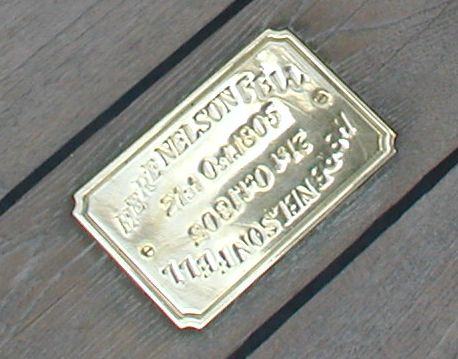
Plaque on HMS Victory Deck, Here Nelson Fell 21st October 1805. Photo credit Stephen D. Yardley
In the meantime Lord Nelson’s remains had been placed in a cask of brandy, as the best means at hand of preserving them, and on the 3rd of November, having refitted, the Victory, accompanied by the Belleisle sailed on the melancholy duty of conveying the body of her hero to England, and, after a most boisterous passage, reached Spithead, on December 4th.
Here she was the object of a most intense and reverential attention, her battered sides, with, in many places, the shot yet sticking in them; her still bloody decks; her jury masts and knotted rigging; — all attested the severity of the ordeal she had gone through; while the flag that still waved, but at half-mast, reminded the spectator that the great Admiral who had such a short time before sailed from that very anchorage to victory, had now, also, returned to his grave. Amongst other injuries, the Victory’s figure-head, a coat of arms supported by a sailor on one side and a marine on the other, was struck by shot, which carried away the legs of the soldier and the arm of the sailor, and the story goes (but we cannot vouch for its truth), that all the men who lost legs in the action were marines, and those who lost arms sailors. The figure-head is still the same, but the wounded supporters have been replaced by two little boys, who, leaning affectionately on the shield, seem certainly more fitted for the peaceful life of Portsmouth Harbour than for the hard times their more warlike predecessors lived in.
The Victory left Spithead on December 11th for Sheerness, which was reached on the 22nd, when the hero’s remains, having been deposited in the coffin made from the mainmast of the L’Orient the French flagship at the Nile, were transferred to Commissioner Grey’s yacht for conveyance to Greenwich, and thence to St. Paul’s. As this was done, Lord Nelson’s flag, which had flown half-mast ever since the action, was lowered for the last time. The Victory then went to Chatham, paid off on the 16th of January, 1806, and underwent another thorough repair.
It was agreed on all sides that the enemy fought harder and more desperately at Trafalgar than they had ever done before, and at the same time it was undeniable that the victory was the most complete ever gained. The exultation that arose in the breasts of all who heard how the pride of the enemy had been humbled, was embittered by the thought that their hero and idol was dead; that he, whose very name ensured victory, would never again lead his ships to the thickest of the fight, and men doubted whether even the triumph of Trafalgar was not too dearly bought. But Nelson had done his work. Never after did the enemy show a large fleet at sea; and he himself fell, as he had often wished, in the moment of victory; leaving behind him an undying fame, and such an example of entire devotion to his country’s service as had never before been equalled in the world’s history.
Mr. Devis, the painter of the picture of the “Death of Nelson,” now on board the Victory, went round in her from Spithead to Sheerness. On the voyage he took portraits of all the characters depicted, and sketched the locality, so that this picture may be considered as a truly historical and faithful one.
- A Short History of HMS Victory, Engagement with the French off Ushant – Part One
- A Short History of HMS Victory, Siege of Gibralta, Occupation of Toulon – Part Two
- A Short History of HMS Victory, Imminent peril of the Victory – Part Three
- A Short History of HMS Victory, Battle of Cape St. Vincent – Part Four
- A Short History of HMS Victory, Blockade of Toulon – Part Five
- A Short History of HMS Victory, Nelson’s pursuit to the West Indies - Part Six
- A Short History of HMS Victory, Battle of Trafalgar – Part Seven
- A Short History of HMS Victory, Death of Nelson, Damage sustained by Victory – Part Eight
- A Short History of HMS Victory, Victory again in Active Service – Part Nine