A Short History of HMS Victory - Part Seven
Battle of Trafalgar
On September 2nd, Captain Blackwood, on his way to London with the news of the combined fleets having left Ferrol, called at 5 a.m. at Merton, where he found Lord Nelson up and dressed; the latter immediately said, “you bring me news of the French and Spanish fleets, I shall have to give them a drubbing yet;” and going up to town with him, offered his services to the Admiralty. These were gladly accepted, and the Victory again hoisted his flag on September 15th, and sailed the same day in company with the HMS Euryalus, Captain Blackwood, which frigate he afterwards despatched ahead to direct that the Victory should not be saluted on her arrival, in order that the enemy should be unaware of the reinforcement. On the 28th of the same month he joined, and took command of, the fleet off Cadiz, which, by the junction of Sir Robert Calder’s ships to Admiral Collingwood’s now consisted of 29 sail.
On October 4th, Nelson dispatched Rear-Admiral Louis with 5 sail of the line to Gibraltar, but a small squadron from England joined a few days afterwards, making up his fleet to the following 27 sail of the line.
| 104 | HMS Victory | Vice-Admiral Lord Nelson, KB, Capt. Thos. Masterman Hardy |
| 100 | HMS Royal Sovereign | Vice-Admiral Cuthbert Collingwood, Capt. Edward Rotherman |
| 100 | HMS Britannia | Rear-Admiral Earl of Northesk |
| 98 | HMS Temeraire | Capt. Eliab Harvey |
| 98 | HMS Prince | Capt. Richard Grindall |
| 98 | HMS Neptune | Capt. Thos. Francis Freemantle |
| 98 | HMS Dreadnought | Capt. John Conn |
| 80 | HMS Tonnant | Capt. Charles Tyler |
| 74 | Belleisle | Capt. William Hargood |
| 74 | Revenge | Capt. Robert Moorsom |
| 74 | Mars | Capt. George Duff |
| 74 | Spartiate | Capt. Sir Francis Laforey, Bart. |
| 74 | Defiance | Capt. Phillip Charles Durham |
| 74 | Conqueror | Capt. Israel Pellow |
| 74 | Defence | Capt. George Hope |
| 74 | Colossus | Capt. James N. Morris |
| 74 | Leviathan | Capt. Henry W Bayntun |
| 74 | Achille | Capt. Richard King |
| 74 | Bellerophon | Capt. John Cooke |
| 74 | Minotaur | Capt. Charles J. M. Mansfield |
| 74 | Orion | Capt. William Codrington |
| 74 | Swiftsure | Capt. William G. Rutherford |
| 74 | HMS Ajax | Lieut. John Pilfold |
| 74 | HMS Thunderer | Lieut. John Stockham |
| 64 | HMS Polyphemus | Capt. Robert Redmill |
| 64 | HMS Africa | Capt. Henry Digby |
| 64 | HMS Agamemnon | Capt. Sir Edward Berry |
Before continuing our narrative, we must again remind our readers that this is but the history of one ship, and that in our account of Trafalgar, only a sufficient general description of the movements of the fleet will be given, to render the Victory’s part intelligible; for details, we must again refer to Jamese’s Naval History, where the most complete account of the action that has been published, will be found.
On 19th October, the Franco-Spanish fleet, of 33 sail of the line, under Admiral Villeneuve, as Commander-in-Chief, and Admiral Gravina, (Spanish), as second, came out of Cadiz, and, after some manoeuvring, at daylight on the 21st, the two fleets were in sight of one another, being then about 20 miles west of Cape Trafalgar. The wind was light, from the W.N.W., and the enemy were in a straggling line on the starboard tack, under easy sail; the British fleet were in two columns on the port tack, and some ten miles dead to windward. At 6.50, the Victory made the signal to bear up, on which the enemy wore together, thus presenting his port broadside to the English fleet, which bore down with a very light wind right aft, and with all studding sails set; the Victory leading the port line, and the Royal Sovereign the starboard, the latter being somewhat in advance.
Thus the British very slowly closed with the enemy. Lord Nelson refusing to allow the Temeraire, his next astern, to take the lead, and thereby bear the brunt of the battle. His Lordship visited the decks of his ship, exhorted his men not to throw away a shot, and was received with cheers as he again went on deck. Having made every other signal to his fleet he thought necessary, he finished with that most celebrated one — “England expects that every man will do his duty,” — which, at 11.40, was hoisted at the Victory’s mizen-topgallant-masthead, and was received by most of the ships with cheers.
This made, Lord Nelson’s customary signal on going into action — “Engage the enemy more closely” — was hoisted at the main, and there remained until the mast was shot away.
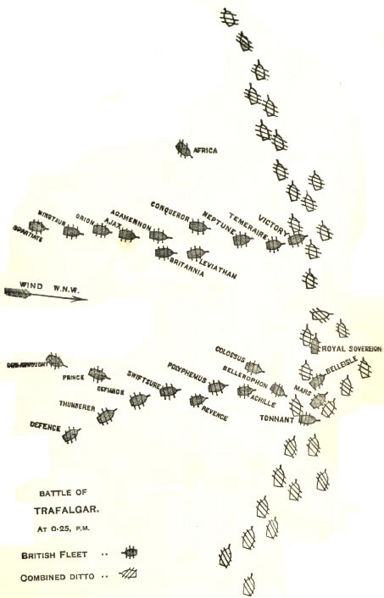
Source: Captain W.J.L. Wharton, RN
At noon, the action commenced by the Fougoeux opening fire on the Royal Sovereign, on which the British Admiral hoisted their flags, and all their ships the white ensign, having also, each, two Union Jacks in the rigging. Twenty minutes later the enemy’s ships ahead of the Victory began a furious cannonade on her, which killed in a short time amongst many others, Mr Scott, Lord Nelson’s secretary. Seeing Nelson’s intention to break the line, the enemy closed up ahead of him, making an almost impenetrable line; but the Victory still held her course, and steered straight for the mass of ships grouped round the Bucentaure, a French 80, on board of which was Villeneuve, the French Commander-in-Chief, though he never showed his flag during the action.
Nelson directed Captain Hardy to run on board any ship he chose, as it was evident they could not pass through the line without a collision, and at 12.30, not having as yet fired a single shot, the Victory passed slowly under the stern of the Bucentaure, so close as almost to be able to catch hold of her ensign, and discharge the port guns in succession right into her cabin windows, placing about 400 men hors de combat, by that one broadside, and almost disabling her from further resistance. The position of the ships at this moment is shown in the accompanying plan.
At the same time the Victory fired her starboard guns at two vessels on that side of her, and five minutes later ran on board the Redoutable, a French 74, hooking her boom iron into the Frenchman’s topsails, and so dropped alongside, the Victory being on the Redoutable’s port side, and the latter closing her lower deck ports to prevent boarding. A tremendous cannonade ensued, the Victory firing her port guns at the Bucentaure and Santissima Trinidada her starboard ones being very fully employed by the Redoutable which was so close alongside, that the men on the Victory’s lower deck on each discharge dashed a bucket of water into the hole made in the enemy’s side by the shot, to prevent the spread of the fire that might have destroyed both ships indiscriminately.
During this time the British ships were coming into action one after another, but very slowly, as the wind, light all the morning, had now fallen to a mere air, barely sufficient to bring all our vessels up thus the first ships engaged had dreadful odds against them, and the loss of life in them was great.
After bringing the Redoutable to close action as before described. Lord Nelson and Captain Hardy, side by side, calmly walked the centre of the quarter deck, from the poop to the hatchway. At about 1.25, in their walk forward his Lordship turned a little short of the hatchway, Captain Hardy took the other step, and turned also, and beheld the Admiral in the act of falling. He had been wounded by a musket ball fired from the mizen-top of the Redoutable, which struck him in the left shoulder as he turned, and thence descending, lodged in the spine. He sank on to the very spot that was still red with his secretary’s blood, and was raised by Sergeant Seeker, of the Marines, and two seamen, who under Captain Hardy’s directions, bore him to the cockpit. “They have done for me at last, Hardy,” said the hero as he fell. “I hope not,” said Hardy. “Yes,” was the reply, “they have shot my backbone through.” But his presence of mind was still strong, and he gave directions for the tautening of the tiller ropes as he was carried below, and covered his face and decorations with a handkerchief, that he might not be recognised.
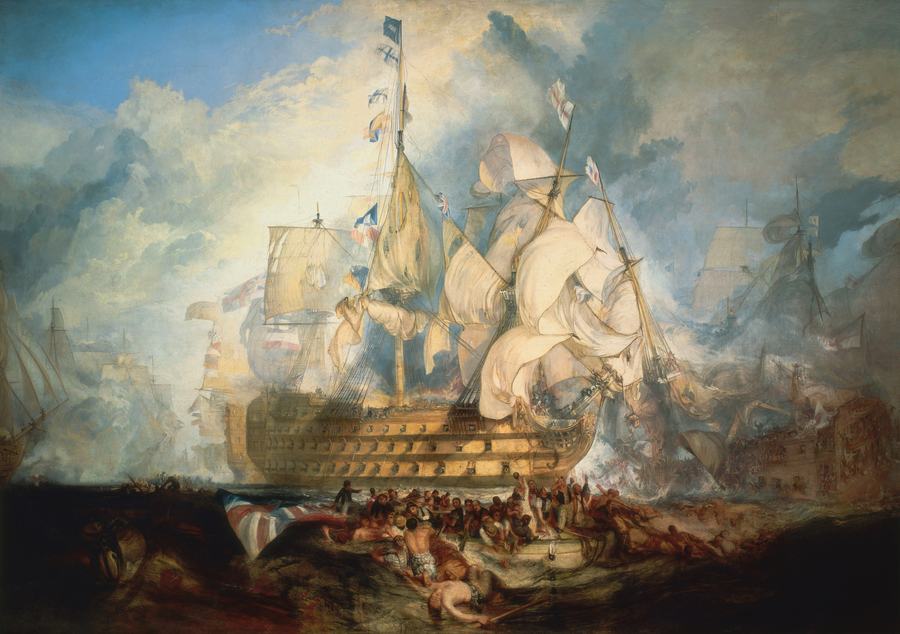
The Battle of Trafalgar by J. M. W. Turner showing the letters of the signal flying from the Victory. National Maritime Museum.
The cockpit was crowded with wounded, and with difficulty he was borne to a place on the port side, at the foremost end of it, and placed on a purser’s bed with his back resting against one of the wooden knees of the ship. Here the surgeon examined his wound, and at once pronounced it mortal.
In the meantime the battle raged furiously, the men stationed in the Redoutablcs tops (Nelson would allow none in the Victory, for fear of setting fire to the sails, had nearly cleared the Victory’s, upper deck, 40 men being killed or wounded on the deck alone. The French, seeing this, attempted to board, but were driven back with great gallantry by the few men that remained, headed by Captain Adair, of the Marines.
At about 1.50 the Redoutable ceased firing, and two midshipmen and a few men were sent from the Victory to assist in putting out a fire that had burst out on board of her, and the Victory then proceeded to get herself clear, leaving her prize lashed to the Temeraire that had just fouled her on the other side. The Victory was by this time so crippled in her spars and sails that all efforts on her part to get into close action (Lord Nelson’s favourite position), with another enemy were ineffectual; but she still continued engaged on the port side with the Santissima Trinidada and other ships; and later, with a fresh batch of the enemy’s ships that passed along the line and eventually escaped.
- A Short History of HMS Victory, Engagement with the French off Ushant – Part One
- A Short History of HMS Victory, Siege of Gibralta, Occupation of Toulon – Part Two
- A Short History of HMS Victory, Imminent peril of the Victory – Part Three
- A Short History of HMS Victory, Battle of Cape St. Vincent – Part Four
- A Short History of HMS Victory, Blockade of Toulon – Part Five
- A Short History of HMS Victory, Nelson’s pursuit to the West Indies - Part Six
- A Short History of HMS Victory, Battle of Trafalgar – Part Seven
- A Short History of HMS Victory, Death of Nelson, Damage sustained by Victory – Part Eight
- A Short History of HMS Victory, Victory again in Active Service – Part Nine