A Short History of HMS Victory - Part Two
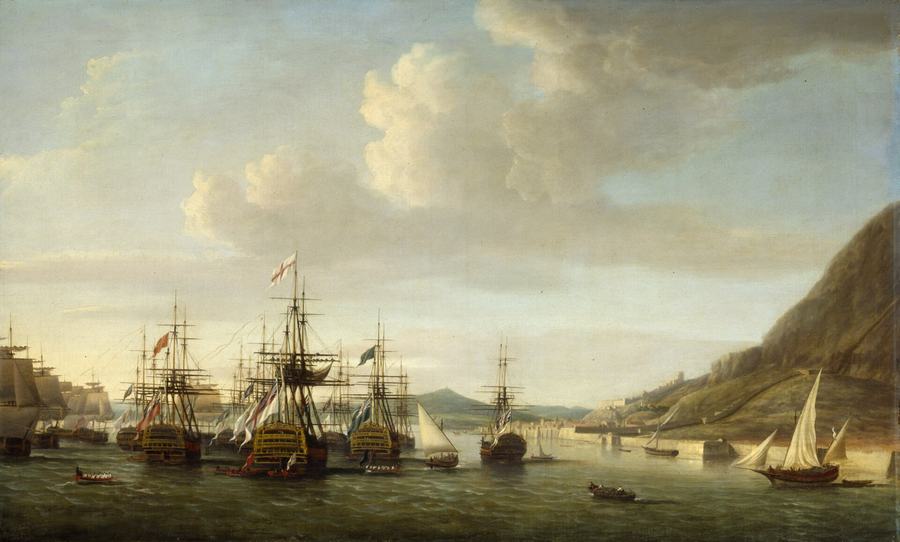
Gibraltar Relieved by Sir George Rodney, 1780. Royal Academy of Arts
At this time, the attention of England, and indeed her enemies, was almost entirely fixed on the defence of Gibraltar by General Elliot, and the probable fate of that fortress, which though it had been besieged by both sea and land for more than three years, had never been so hardly pressed as now. Admiral Darby with a powerful fleet had relieved the garrison from the greatest possible distress the year before, but the supplies he then landed were now nearly exhausted, the garrison were again commencing to feel the pangs of hunger, and it was well known that the Spaniards had been for months making preparations for an attack of a new kind, and on a grand scale, which they trusted would compel the proud stronghold to lower its colours. The new feature in the attack was the construction often large floating batteries, so covered and protected as to be considered practically invulnerable; these were armed with 154 pieces of the heaviest ordnance, and backed up as they were by 48 French and Spanish sail of the line, and 40,000 troops, the expected assault was enough to make England tremble for the result. It was accordingly resolved to make a great effort to relieve Gibraltar, and in such a manner that it should be not only a temporary but a permanent relief and to this end a fleet of 36 sail of the line was got together, which was to convoy a large number of merchantmen, laden with every description of supplies, and carrying troops to reinforce the garrison.
Occupation of Toulon
The first object of importance in the Mediterranean was the reduction of Toulon if possible. In that port, the great Southern French Arsenal, were known to be upwards of 30 sail of the line, 17 of them ready for sea, under the orders of Admiral Trogoff, but as that officer was a staunch monarchist, he was not expected to do anything that would further the cause of republicanism, and the existence of a strong royalist party in the south of France, favoured the supposition that instead of resisting the British, the Toulonese would receive them with open arms, as their only chance of protection from that republic they so thoroughly hated and feared.
Such being the posture of affairs. Hood hurried out to his station, watering his ships at Cadiz, (for Spain was now our ally against the common enemy) and Gibraltar. From the latter place the fleet sailed, on June 27th, and on the 7th July fell in with a Spanish fleet of 24 sail whose Admiral sent a message to Lord Hood, to say that he had 1900 men sick and was going into Carthagena, and, said the Captain of the frigate “no wonder, for we have been 60 days at sea.” This speech did not raise their new allies in the estimation of the British, who laughed at such a notion, and left the Spaniards to follow to Toulon, which was sighted on the 19th July, and a flag of truce was sent in to propose an exchange of prisoners. To this the enemy would not accede, but they were now acquainted with the presence of Lord Hood’s fleet off the port, and those causes of dissension we have mentioned began to operate, with the most important final results.
Lord Hood cruised for a fortnight in sight of Toulon, then sailed for Nice to show himself there, and on his return on 20th August, heard that proposals were being made in Toulon to put themselves under his protection. On the 23rd, Commissioners came on board the Victory from Marseilles with full powers to treat for peace, offering a conditional surrender of Toulon and all the shipping, declaring a monarchical government the leading object of their negotiation, and praying for speedy help against the armies of the convention that were at that moment approaching.
Our space will not permit a full account of the proceedings at this time, and we must satisfy ourselves by stating that Toulon was taken possession of on the 27th August, without a blow, despite the threatened opposition of Admiral St Julien, the second in command, who was thorough republican; the Spanish fleet hove in sight the same day, and Toulon was soon occupied by the combined forces, and vigorous steps taken to keep possession of our “extraordinary acquisition,” as Nelson in one of his letters calls it. But the enemy were at hand, mustering stronger and stronger every day, and by November, General Dugommier was besieging the town with 40,000, men, while the defenders, who only mustered 16,000, were of different nationalities and had to man a line 15 miles in length. On December 16th a position on the heights commanding Toulon was carried by the besiegers, and a council of war, hastily summoned, determined to evacuate the town, carry off as many ships as possible, and burn the rest. The evacuation was carried out successfully, the troops and seamen were all embarked, and 15,000 of the inhabitants took refuge from the rage of their countrymen on board the fleets. But the rest of the programme was not so completely performed; the Spaniards had charged themselves with the destruction of the ships in the inner harbour, but either by carelessness or treachery, they very imperfectly performed their task. They did not fire the ships of war but did set alight to the powder vessels which it was arranged should be scuttled; these blew up, nearly destroying Captain Sidney Smith, who was burning the ships in the outer mole; he gallantly attempted to repair the omission, but was repulsed by the fire of the republicans who were already in the town, and had to retire, leaving the work but half done. Of 58 ships in the port when Lord Hood arrived, 14 were destroyed, 19 carried off, and 25 left to the French.
- A Short History of HMS Victory, Engagement with the French off Ushant – Part One
- A Short History of HMS Victory, Siege of Gibralta, Occupation of Toulon – Part Two
- A Short History of HMS Victory, Imminent peril of the Victory – Part Three
- A Short History of HMS Victory, Battle of Cape St. Vincent – Part Four
- A Short History of HMS Victory, Blockade of Toulon – Part Five
- A Short History of HMS Victory, Nelson’s pursuit to the West Indies - Part Six
- A Short History of HMS Victory, Battle of Trafalgar – Part Seven
- A Short History of HMS Victory, Death of Nelson, Damage sustained by Victory – Part Eight
- A Short History of HMS Victory, Victory again in Active Service – Part Nine